Do Car Salesmen Make More on New or Used Cars?
It depends on two numbers: the front gross a unit carries on each side, and how many units you'll sell. On many plans, used pay rides on front gross while new-car pay leans on minis, spiffs and volume bonuses. In our worked example, the used plan paid more at equal volume, and the new plan won once it sold about a third more units.
Search this and you get vendor blogs, a news site, a Q&A thread, a career blog and a rival tool's blog. Most repeat a general gross range for each side. None of them works a month on each side and compares the checks.
That's what this does. Every pay figure below comes from the free car salesman commission calculator, run on two plans and two sets of deals that are labelled as illustrations. Enter your own store's numbers for each side and the answer is yours, not ours.
Why is there no single answer?
Because your month is units times what each unit pays, and new and used differ on both.
A new unit and a used unit go through the same formula. Front gross, minus the pack, times your rate, with the mini underneath. That's covered in how much a car salesman makes per car, along with why the sticker price isn't in the formula. What changes between the two sides is the gross each deal carries, the plan the store wrote for that side, and how many deals a rep gets through in a month.
So "which pays more" is really three questions. Which side carries more gross per deal at your store? Which plan pays more of it? And which side gives you more units?
What do the published numbers say?
The best public source is NADA Data 2025, the annual financial profile of America's franchised new-car dealerships. Two of its figures matter here.
| NADA Data 2025 | New | Used |
|---|---|---|
| Average retail selling price, 2025 | $48,205 | $28,680 |
| Retail units per salesperson a year, 2018 to 2025 | 102 to 114 | 137 to 148 |
| Roughly, per month | About 9 | About 12 |
Used salespeople at franchised stores averaged roughly 30 more units a year. New units carried a far higher ticket. Neither number is your gross. A higher selling price doesn't mean more gross after the pack, and the commission formula doesn't use the price at all.
Gross is the number you actually need, and it's harder to find. The Haig Report put used-vehicle gross profit per vehicle retailed at $1,668 in the second quarter of 2025, as reported by Haig Partners. That's the whole store's gross on the vehicle, before any pack. We couldn't find a new-vehicle front gross from a primary source we could check, so we won't print one.
Your store's numbers will be different from any national average, in either direction. Ask for them.
How does the same month pay on a new plan and a used plan?
Here are two plans, both illustrations. They're shaped the way new and used plans often differ: a smaller pack and a bigger mini on new, with manufacturer spiffs passed through, and a bigger pack on used.
| Illustration | New-car plan | Used-car plan |
|---|---|---|
| Rate | 25% of front gross | 25% of front gross |
| Pack | $300 | $1,000 |
| Mini | $250 | $150 |
| Spiffs | $100 on every other unit | None |
| Volume bonus | $500 at 10 units, $1,000 at 15, $2,000 at 20 | The same |
| Front grosses, repeating | $600, $1,000, $1,400, $800, $1,200, $2,000 | $1,200, $2,400, $3,000, $1,800, $2,600, $4,000 |
| Average front gross | About $1,167 | $2,500 |
Now the month, at four different unit counts, with no draw and no base:
| Units in the month | New-car plan pays | Minis on new | Used-car plan pays | Minis on used |
|---|---|---|---|---|
| 6 | $2,000 | 4 | $2,350 | 1 |
| 9 | $2,975 | 6 | $3,350 | 2 |
| 12 | $4,500 | 8 | $5,200 | 2 |
| 16 | $6,225 | 11 | $6,900 | 3 |
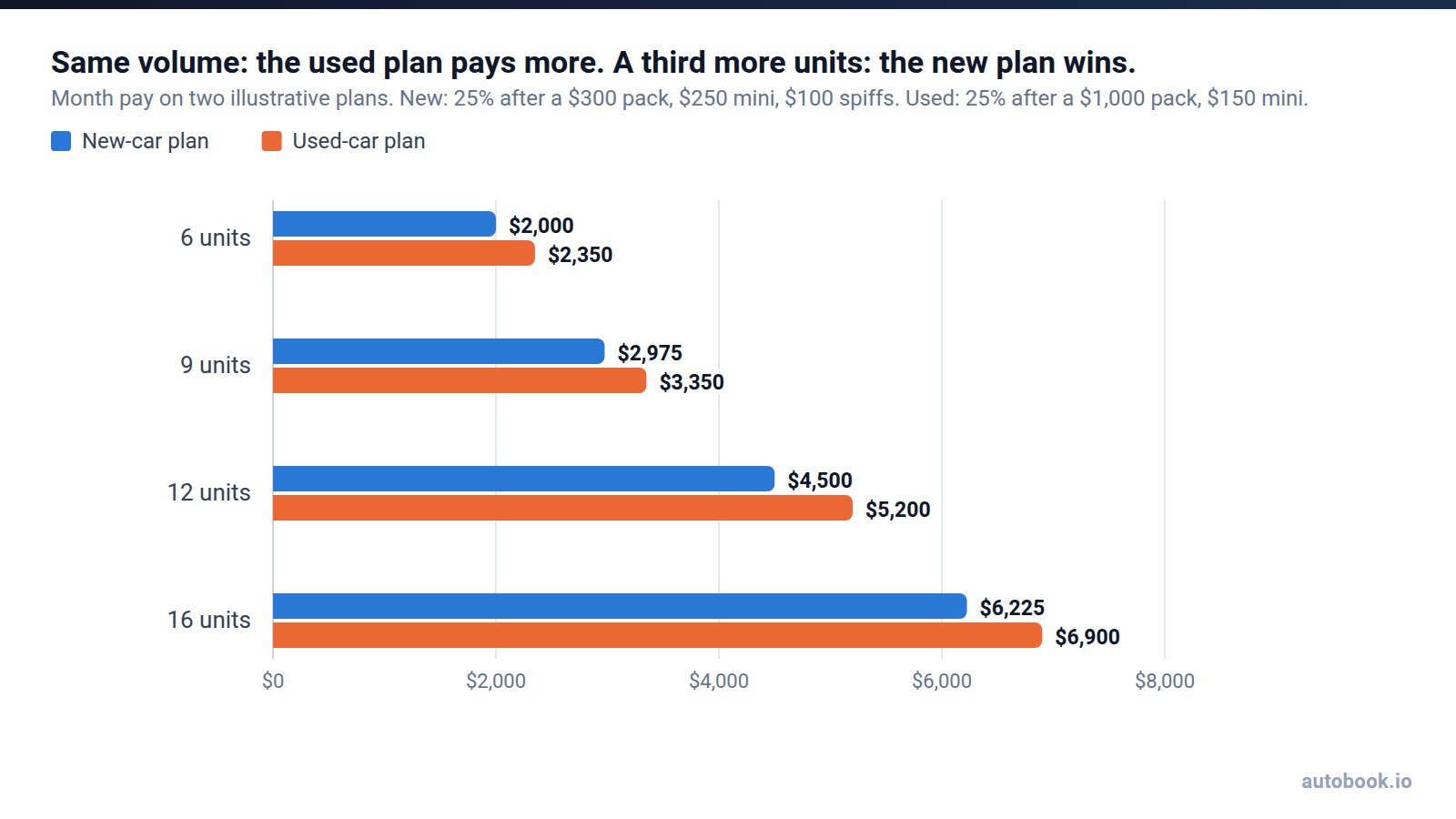
At the same unit count, the used plan pays more on every row, because its deals carry more than twice the gross. The new plan's bigger mini and its spiffs close some of the gap, never all of it.
Change the unit count and the answer flips. The new plan at 12 units pays $4,500, more than the used plan at 9. At 16 units it pays $6,225, more than the used plan at 12. In this example, the new side needs about a third more units to win.
NADA's averages run the other way, though: used salespeople sold more units, not fewer. On those averages, about 9 new against about 12 used, this example pays $2,975 against $5,200. If a new-car store wants you, ask how it makes up the difference. More units per rep, bigger spiffs, a richer mini or bigger tiers are the usual places to look.
Where does the money come from on each side?
Look inside the 12-unit month and the two plans pay you for different things.
| 12-unit month | New-car plan | Used-car plan |
|---|---|---|
| Minis | 8 deals, $2,000 | 2 deals, $300 |
| Percentage of gross on the other deals | $1,400 | $4,400 |
| Spiffs | $600 | $0 |
| Volume bonus | $500 | $500 |
| Total | $4,500 | $5,200 |
| Share from minis, spiffs and the bonus | 68.9% | 15.4% |
On the new plan, more than two-thirds of the month came from the floor, the spiffs and the bonus. On the used plan, most of it came from gross. That changes what a good month looks like on each side.
On new, the count is everything. Every unit is at least a mini and a step toward the next tier, so the rep who sells one more unit beats the rep who holds a little more gross. Where the mini stops and the percentage starts on your own plan is in how to calculate car sales commission.
On used, the gross is everything. A desk that gives a deal away costs you a percentage of it, and a bigger pack takes a fixed bite out of every deal above the mini.
Which side holds up in a slow month?
Take $300 of front gross off every deal in the 9-unit month and run it again.
| 9 units | New-car plan | Used-car plan |
|---|---|---|
| Ordinary month | $2,975 | $3,350 |
| Every deal $300 thinner | $2,850 | $2,850 |
| What the thin month cost you | $125 | $500 |
| Minis in the thin month | 8 of 9 | 3 of 9 |
The new plan barely noticed. Most of its deals were already at the mini, and a mini doesn't shrink when the gross does. The used plan lost four times as much, because nearly every dollar of gross it gave up was a dollar it paid 25% on.
That's the trade. A plan built on minis and spiffs pays less in a strong month and protects you in a thin one. A plan built on gross does the opposite.
What about manufacturer money?
Manufacturer money paid to the store, such as a stair-step program, isn't part of your commission unless your plan says so. Holdback works the same way on many plans; the sentence to look for is in is holdback included in car sales commission.
A manufacturer spiff passed through to you is different. It's flat money on a unit, and it goes on the spiff line of your commission sheet. On a new-car plan, those spiffs can be a real share of the month, as the table above shows. Ask which models carry them and whether they change month to month.
How do you compare a new-car offer with a used-car offer?
- Get both plans in writing. Rate, pack, mini, tiers, spiffs, back-end, draw. A plan nobody will write down is a plan that can change.
- Ask each side's average front gross. The sales manager knows it for the last few months. It's the most important number in the comparison.
- Ask how many units a rep on each side actually sells. Not the top rep. The middle of the board.
- Enter each side as its own plan in the commission calculator, with its own grosses and unit count. Use Copy link to my plan for each, so you can open both side by side.
- Run a thin month on each. Lower the average gross and see which check holds.
Six whole plan shapes, run on the same deals, are in car salesman pay plan examples. The non-pay questions, like how ups are rotated and who buys the used inventory, are in the best dealership to work for as a salesman.
Where do more units come from on either side?
The plan is the store's. The count is the part you can move, and on a new-car plan especially, one more unit is at least a mini and a step toward a tier.
More units come from more buyers, and a lot of them are already shopping Facebook Marketplace near you. autobook.io imports your dealership's inventory from its website, new and used, and writes an editable description for each unit. It posts them to Marketplace from your own profile, in your own browser, in batches of up to 50. Posting a vehicle by hand takes 10 to 15 minutes. You still choose the units, answer every buyer in Messenger and close, and the buyers take roughly 40 minutes a day. It removes the grind, not the job. Plans start from $99/month, and across the network about one in nine posted vehicles sells.
Frequently asked questions
Do used car salesmen make more than new car salesmen?
The national averages don't settle it. NADA Data 2025 puts used salespeople at franchised stores at 137 to 148 units a year against 102 to 114 for new, while new units carry the higher selling price. Your store's plan, gross and volume decide it.
Is the commission percentage different on new and used?
It can be. Some stores write a different rate, pack or mini for each side, which means you're on two plans. Enter each one separately in the calculator.
Why are there so many mini deals on new cars?
On many plans, new deals carry thin front gross, and a thin deal pays the mini. On our example plan, any deal up to $1,300 of front gross paid the $250 mini, and 8 of 12 new deals did.
Do salespeople get paid on manufacturer incentives?
Not unless the plan says so. Manufacturer money paid to the store isn't part of your commission. A manufacturer spiff passed through to you goes on the spiff line.
Should I switch from new to used to make more?
Run both before you decide. Enter each store's plan, its average gross and a realistic unit count in the calculator, then run a thin month on each. The bigger number in an ordinary month isn't always the safer job.