Car Salesman Pay Plan Examples: 6 Plans, Same Month
Car salesman pay plans come in six common shapes. The classic pays a percentage after a pack, with a mini. The others are a lower rate with a small pack, a high rate with a big one, flat per unit, salary plus a smaller percentage, and a retro tier. Six examples run through one 12-unit month land within $540. At 8 or 16 units, they don't.
Every page ranking for this search shows you one pay plan. One tells you almost nothing, because your real question is how it compares with your plan, or with the one you've been offered.
So here are six, run through the same deals, then through a slow month and a strong one, where plans that look alike on paper stop looking alike. Every figure comes from the free car salesman commission calculator, so you can enter any plan below and check the line yourself.
What do the six example pay plans look like?
These are illustrative shapes, not any store's plan. We picked numbers that land close together on an ordinary month, so the differences you see later come from the shape, not the size. If a term is new, car salesman pay plans, explained defines each one. The short version: the pack comes off gross before your percentage, and the mini is the floor on any deal.
| Plan | Shape | How each deal pays | Volume bonus |
|---|---|---|---|
| A | Percent of gross, pack and mini | 25% after an $800 pack, $150 mini | $500 at 10 units, $1,000 at 15, $2,000 at 20 |
| B | Lower rate, small pack | 20% after a $300 pack, $150 mini | Same as A |
| C | Flat per unit | $325 a unit, whatever the gross | Same as A |
| D | High rate, big pack | 30% after a $1,200 pack, $150 mini | Same as A |
| E | Base salary plus a smaller percentage | $1,500 a month, plus 15% after a $500 pack, $100 mini | None |
| F | Retro tier | 20% after an $800 pack, $150 mini, then 30% on every deal once you reach 12 units | None beyond the retro rate |
Plan A is the calculator's starting plan. To enter a flat plan like C, set the percentage to 0% and the mini to the flat. Some flat plans raise the per-unit amount past a count instead of paying a lump. The calculator pays lumps, so Plan C does too.
The month is 13 deals. Eleven are full deals, with front grosses of $600, $900, $1,200, $1,500, $1,800, $1,800, $2,000, $2,200, $2,500, $3,400 and $4,000. Two are splits, at $1,800 and $2,400. Two halves count as one unit, so it's a 12-unit month averaging $2,000 of front gross a unit. Back-end is zero on every plan, to keep the comparison about the front.
Which pay plan pays the most on a 12-unit month?
Plan B, by a little. Here's the whole field:
| Plan | Paid on the deals | Bonus or salary | Pay for the month |
|---|---|---|---|
| A: 25% after $800 | $3,975 | $500 bonus | $4,475 |
| B: 20% after $300 | $4,200 | $500 bonus | $4,700 |
| C: $325 flat | $3,900 | $500 bonus | $4,400 |
| D: 30% after $1,200 | $3,660 | $500 bonus | $4,160 |
| E: $1,500 salary + 15% | $2,825 | $1,500 salary | $4,325 |
| F: 20%, retro 30% at 12 | $4,680, all at 30% | None | $4,680 |
$540 separates the best plan from the worst. That's real money, and it's also the smallest gap in this article.
Plan B wins because its $300 pack leaves more of each deal to pay on. At a $2,000 average, a small pack beats a higher rate. Plan D comes last for the opposite reason: its $1,200 pack eats most of the gross on the small deals, and it paid the mini on four of the 13. Plan F finishes second only because 12 is exactly its line, so every deal was re-paid at 30%.
Which plan protects a slow month, and which pays off in a strong one?
Take four deals out and you have an 8-unit month: drop the $600, $1,800, $2,200 and $3,400 deals. Add four and you have a 16-unit month: $1,200, $1,800, $2,200 and $2,800. All three months average $2,000 of front gross a unit, so the only thing that changes is volume.
| Plan | 8 units | 12 units | 16 units | 8 to 16 units adds |
|---|---|---|---|---|
| A: 25% after $800 | $2,575 | $4,475 | $6,225 | $3,650 |
| B: 20% after $300 | $2,750 | $4,700 | $6,560 | $3,810 |
| C: $325 flat | $2,600 | $4,400 | $6,200 | $3,600 |
| D: 30% after $1,200 | $2,370 | $4,160 | $5,770 | $3,400 |
| E: $1,500 salary + 15% | $3,340 | $4,325 | $5,225 | $1,885 |
| F: 20%, retro 30% at 12 | $2,130 | $4,680 | $6,150 | $4,020 |
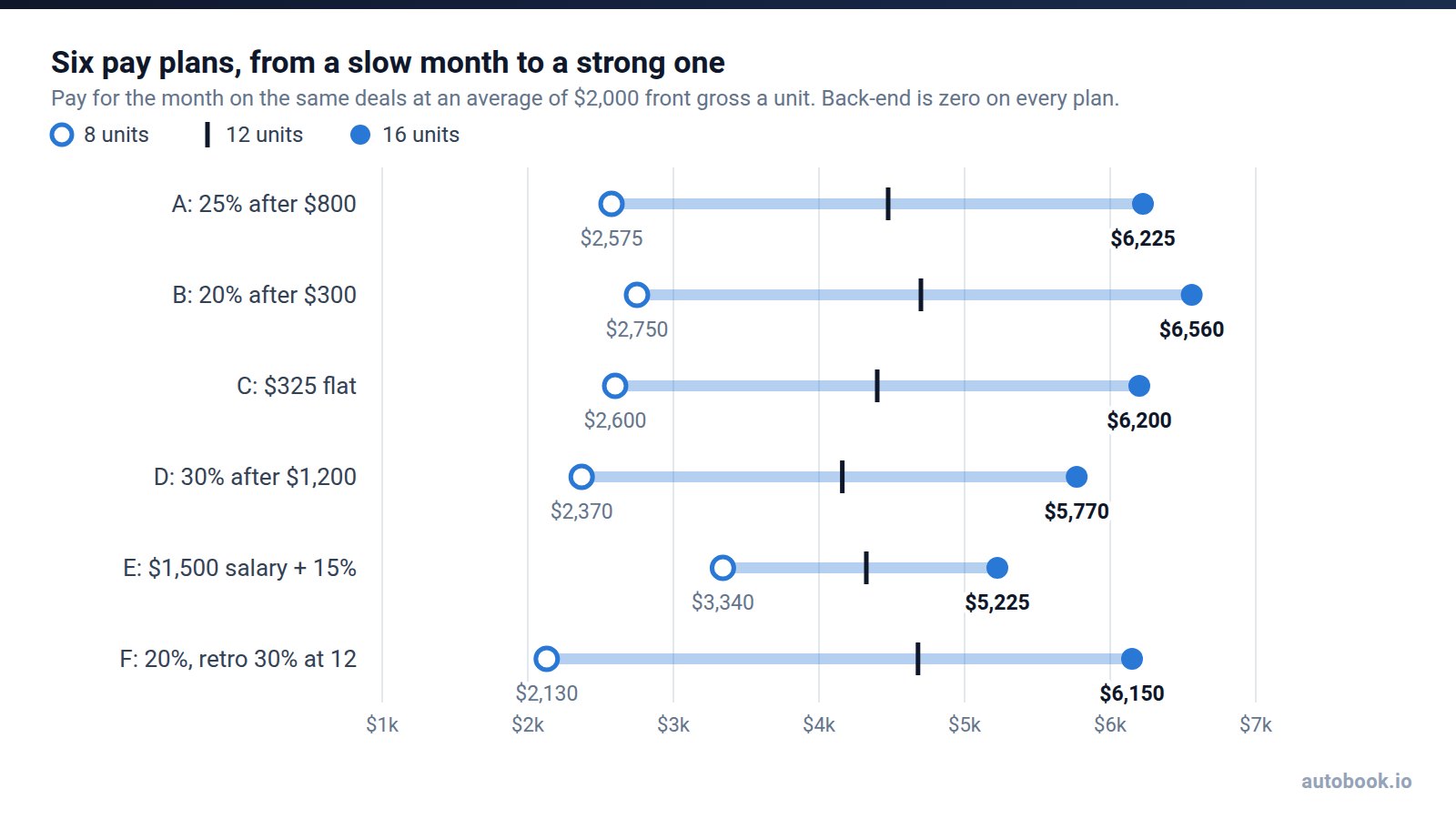
Now the plans separate. In the slow month, Plan E pays $3,340 and Plan F pays $2,130, a gap of $1,210. In the strong month, Plan B pays $6,560 and Plan E pays $5,225, a gap of $1,335.
The salary is what protects Plan E: the $1,500 arrives whatever you sell, so a bad month hurts least. The price is in the climb. With a smaller percentage and no bonus grid, eight extra units add $1,885, roughly half what they add on the other five.
Plan F is the mirror image. In the slow month it's the lowest-paying plan here, and above its line every deal pays 30%. The line itself is a cliff. Take the $2,000 deal out of the 12-unit month and Plan F pays $3,040 for 11 units, $1,640 less than it paid for 12. What a unit at the line is worth, on flat and retro grids, is worked out in what a car sales volume bonus is really worth.
What if your deals carry more gross?
Then the order flips. Here's the same 12-unit month with $1,500 more front gross on every deal, for a $3,500 average:
| Plan | 12 units at a $2,000 average | 12 units at a $3,500 average |
|---|---|---|
| A: 25% after $800 | $4,475 | $8,600 |
| B: 20% after $300 | $4,700 | $8,180 |
| C: $325 flat | $4,400 | $4,400 |
| D: 30% after $1,200 | $4,160 | $8,780 |
| E: $1,500 salary + 15% | $4,325 | $6,900 |
| F: 20%, retro 30% at 12 | $4,680 | $9,720 |
Plan D goes from last to second. Plan B drops from first to fourth. Plan C doesn't move at all: a flat plan pays $4,400 on 12 units whether the store made $2,000 a deal or $3,500.
On a single deal, Plan D pays the same as B at $3,000 of front gross ($540 each) and the same as A at $3,200 ($600 each). Above those, the big pack stops hurting and the high rate takes over. The formula behind that, with a full two-plan break-even, is in how to calculate car sales commission.
Which pay plan suits which rep?
Read your own last three months before you read the plan. The shape that suits you depends on two numbers: your average front gross, and how steady your count is.
- High volume, thin grosses. Plan B's small pack or Plan C's flat protects you. Deals near the pack still pay something, and a flat plan doesn't care what the desk held.
- Fewer units, fat grosses. Plan D rewards you when most of your deals clear $3,200 of front gross. At our $2,000 average, it finishes last or second to last every month.
- New, or at a slow store. Plan E's salary keeps a bad month survivable. You pay for that in every good one.
- Steady, and sure of the count. Plan F adds the most between a slow month and a strong one, and comes first when grosses run high. Miss the line by one unit and it drops $1,640.
- Somewhere in between. Plan A is never first and never last in any table here.
Is a base salary the same as a draw?
No. None of the tables above includes a draw, because a draw doesn't change what you earn. It changes when you're paid. A draw is an advance against commission, so it comes back out of the month-end check.
Put a $2,000 recoverable draw on Plan F's slow month and the month-end check is $130. The draw already paid the rest. Plan E's $1,500 salary works differently: it sits on top of commission, and nothing is taken back. What happens month by month when commission doesn't cover the draw is in do car salesmen get paid if they don't sell.
Federal law is why none of these plans mentions overtime. Salespeople primarily engaged in selling vehicles at a dealership are exempt from overtime under 29 U.S.C. § 213(b)(10). The exemption covers overtime, not minimum wage, and state rules can add to it.
Which lines in a written plan change the numbers most?
Not the percentage. These are the sentences that move the tables above, and each is worth getting in writing:
- What counts as gross. Which costs sit inside the figure your percentage applies to.
- The pack. One fixed number, or one that changes by vehicle or by month.
- The tier. Flat or retro, and whether a retro rate re-pays every deal or only the ones after the line.
- Splits. Half a unit each toward the tier, or something else.
- The draw. Recoverable or not, and what happens to a deficit if you leave.
- Back-end. Your percentage of which number, if any.
That last one can be large. A 5% back-end on $1,500 of finance gross a deal adds $900 to Plan A's 12-unit month, and the same $900 to any plan that pays it that way. The rest of the job decision, from how ups are rotated to units per rep, is in the checklist for judging a dealership.
How do you compare a job offer with your current plan?
Run both through the same month. Open the commission calculator, enter your current plan, switch to Deal by deal and type in last month's deals, splits included. Press Copy link to my plan. Then change the plan fields to the offer and copy a second link. Each link reopens that plan with the month intact, so you can flip between them. Nothing you enter is sent to a server.
Then do it twice more: once with your worst month of the last year, once with your best. A plan that wins your average month and loses your worst one is a bet on your own consistency. Take it knowingly.
What raises your pay on any of these plans?
Look back at the 8, 12 and 16 table. On every plan, going from 12 units to 16 is worth at least $900, and on five of the six it's worth more than $1,400. Both beat the $540 between the best and worst plan. Choosing well matters. Four more units matter more. The box beneath the calculator's results shows what a few more units a month would pay on your plan.
More units come from more buyers, and the cheapest ones left are already shopping Facebook Marketplace near you. autobook.io imports your dealership's inventory from its website and writes an editable description for each unit. It posts them to Marketplace from your own profile, in your own browser, in batches of up to 50. Posting a vehicle by hand takes 10 to 15 minutes. You still choose the units, answer every buyer in Messenger and close the deal, and that takes real time: roughly 40 minutes a day on buyer messages. It removes the grind, not the job. Plans start from $99/month, and across the network about one in nine posted vehicles sells.
Frequently asked questions
Is a flat per-unit pay plan better than commission?
It depends on your gross. A flat plan pays the same whatever the desk holds. In these examples, a $325 flat pays $4,400 on 12 units at a $2,000 or a $3,500 average, while 25% after an $800 pack pays $4,475 and then $8,600.
What is a retro pay plan in car sales?
One where reaching a unit count raises your percentage on every deal that month, not just the ones after it. In Plan F, 20% becomes 30% at 12 units. Twelve units pay $4,680, and the same month one unit short pays $3,040.
Is a base salary better than a draw?
For a slow month, yes. A salary is yours, and a recoverable draw comes back out of later commission. The trade-off in Plan E is a smaller percentage and no bonus grid, so it paid the most of the six at 8 units and the least at 16.
Do these examples include back-end, chargebacks or taxes?
Back-end is zero, so every figure is front commission plus bonus or salary. The calculator doesn't model chargebacks, taxes or house deals, so it shows gross pay before any of them.
Can I send my plan to someone to compare?
Yes. Copy link to my plan puts the whole plan and month in the link. Nothing is sent to a server, so the link is the only copy.