How Much Does a Car Salesman Make on a $30,000 Car?
The price of the car doesn't set the check. The front-end gross left after the pack does. On a plan paying 25% after an $800 pack, with a $150 mini, a $30,000 car pays $150 at $1,000 of front gross, $250 at $1,800 and $675 at $3,500. A $50,000 car at $1,000 of front gross pays the same $150.
The pages ranking for this question give you a percentage range and a dollar range. Neither comes with a plan or a deal you could check. The buyer who searched it gets a number. The rep who searched it gets nothing they can check against a commission sheet.
So here's the math instead, on a $30,000 car and a $50,000 car, with every figure run through the free car salesman commission calculator. Its Deal by deal tab takes one deal at a time, so you can enter any row below and check it, then enter your own.
Why doesn't the price of the car set your commission?
Because on a gross plan, the price isn't in the formula. Your percentage applies to front-end gross, which is what the store made on the vehicle itself: the selling price minus what the store has in it. The pack comes off that first. Then the mini sets a floor under the result.
A $50,000 car can carry more gross than a $30,000 one. It can also carry less. What the store paid for it, what the market will pay and how hard the buyer pushed decide that, and none of them follow the sticker. The full argument, with published gross figures, is in car salesman pay plans, explained.
How much does a salesman make on a $30,000 car, and on a $50,000 one?
Here are both vehicles at three front grosses each: a thin deal, an ordinary one and a strong one. The plan is the calculator's starting plan: 25% after an $800 pack, a $150 mini, no back-end. The grosses are illustrations, not any store's numbers.
| Vehicle price | Deal | Front gross | After the $800 pack | At 25% | You're paid |
|---|---|---|---|---|---|
| $30,000 | Thin | $1,000 | $200 | $50 | $150, the mini |
| $30,000 | Ordinary | $1,800 | $1,000 | $250 | $250 |
| $30,000 | Strong | $3,500 | $2,700 | $675 | $675 |
| $50,000 | Thin | $1,000 | $200 | $50 | $150, the mini |
| $50,000 | Ordinary | $2,500 | $1,700 | $425 | $425 |
| $50,000 | Strong | $5,000 | $4,200 | $1,050 | $1,050 |
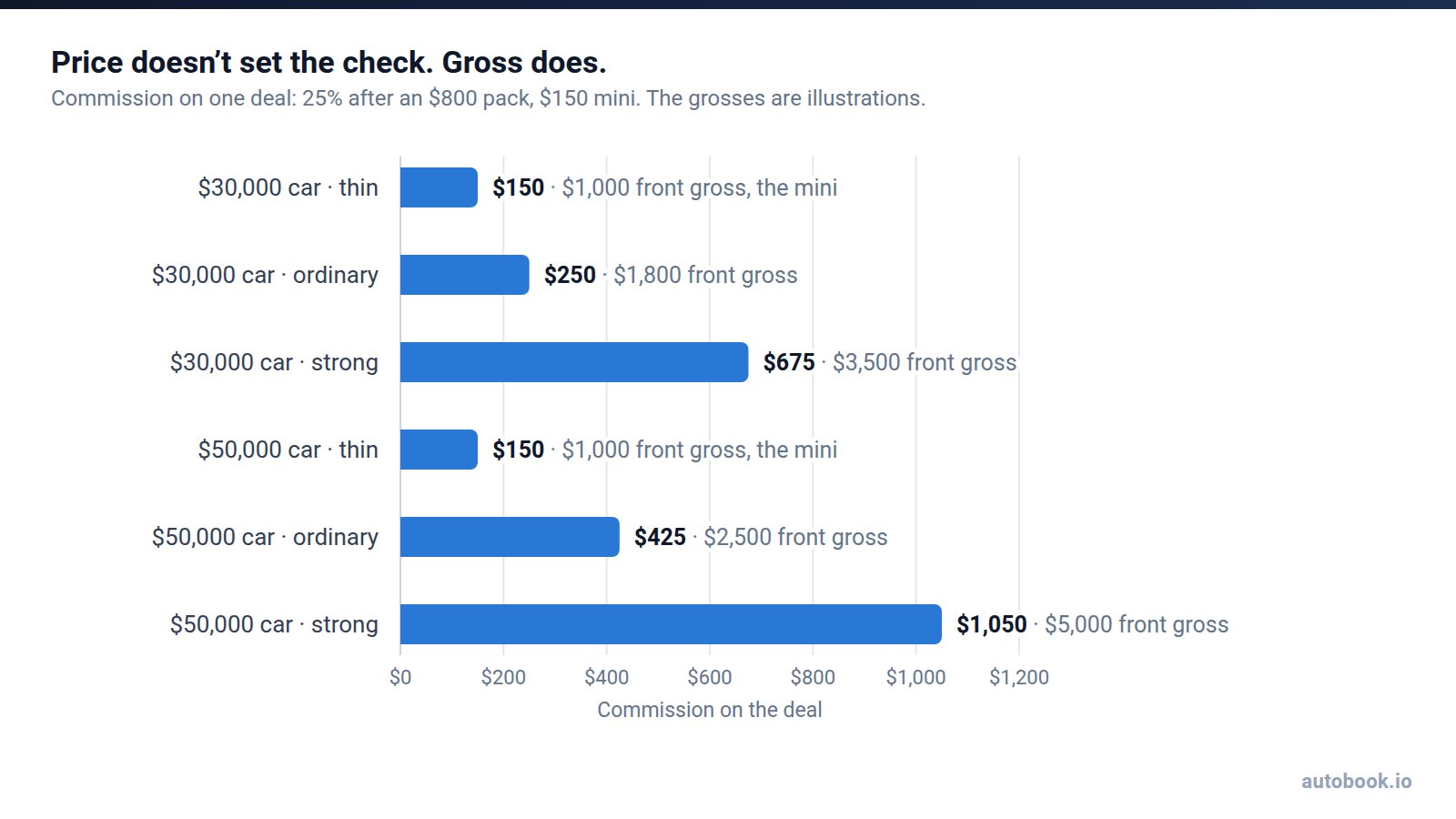
Start with the two thin deals. Twenty thousand dollars more vehicle, and not one dollar more commission. On this plan, anything up to $1,400 of front gross pays the same $150. Every dollar between the $800 pack and $1,400 changes the store's number and not yours. That's the mini dead zone, and how to calculate car sales commission shows where it sits on your plan.
Then compare the strong $30,000 deal with the ordinary $50,000 one. The cheaper vehicle pays $675. The dearer one pays $425. The price column is the only one that doesn't move your check.
What adds to the check, and what takes it away?
The table above is front commission only. Real deals carry more lines than that, some in your favor and some not. Here is the ordinary $1,800 deal, one change at a time.
| What changes on the $1,800 deal | How it's figured | You're paid |
|---|---|---|
| Nothing | 25% of $1,000 | $250 |
| Your plan pays 5% back-end, on $1,500 of finance gross | Plus $75 | $325 |
| A $100 spiff on the unit | Plus $100 | $350 |
| The $500 bonus for 10 units, spread over a 10-unit month | Plus $50 a unit | $300 |
| Split with another rep | Half the pay, half a unit | $125 |
| A $1,000 pack instead of $800 | 25% of $800 | $200 |
| An $800 overallowance on the trade, charged to the deal | Front gross drops to $1,000 | $150, the mini |
Back-end only counts if your plan pays it. The calculator's starting plan pays none, and yours may not either. Spiffs are flat money on a unit, so a thin deal with a spiff can out-earn an ordinary deal without one.
The bonus line is the one that confuses per-unit numbers most. Spread across the month, it adds $50 to every unit here. But nobody sells the bonus one unit at a time. The unit that crosses the line earns its own commission plus the whole bonus. What that unit is worth on flat and retro grids is worked out in what a car sales volume bonus is really worth.
The last three rows take money away. A split halves everything. A pack that's $200 bigger costs $50 on any deal that stays above the mini. And an overallowance, on plans that charge it against the deal's front gross, can push an ordinary deal all the way down to the mini. How that gets decided at the desk, and when it's worth giving up, is in the pay plan teardown.
Is it different on a new car and a used one?
The formula isn't. Front gross, minus the pack, times your rate, with the mini underneath, works the same on both. What changes is the gross the deal carries, and sometimes the plan itself: if your store runs a different pack or rate on new and used, you're really on two plans. Manufacturer money paid to the store, such as a stair-step program, isn't part of your commission unless your plan says so. A manufacturer spiff that's passed through to you is a spiff, and it goes on the spiff line. If your two sides pay differently, enter each as its own plan in the calculator and copy a link for each.
Why do published per-car averages disagree?
Because "per car" isn't one number. It's a choice about what to divide by what, and a figure with no method attached doesn't tell you which choice it made.
Take one month on the starting plan, shaped like the calculator's own starting month: 10 full deals and 2 splits. The full deals grossed $900, $1,200, $1,400, $1,800, $1,800, $2,000, $2,400, $2,800, $3,500 and $5,000. The splits grossed $1,800 and $2,400. That's 11 units, $4,200 of front commission and the $500 bonus for passing 10. Now count it five ways.
| How "per car" is counted | Per car |
|---|---|
| The middle deal: sort the 12 checks and take the middle two | $250 |
| Front commission divided by 12 deals | $350 |
| Front commission divided by 11 units | $382 |
| Front commission plus the bonus, divided by 11 units | $427 |
| The same, if the plan also paid 5% of $1,500 back-end on every deal | $502 |
Same deals, same rep, same month. The answer doubles depending on how you count it. The calculator's Commission per car is the fourth row here, or the fifth once back-end is in, because it divides everything except base salary by units.
Look at the deals themselves, too. Three of the twelve paid $150 each. The $5,000 deal alone paid $1,050, a quarter of the month's front commission. Take that one deal out and the calculator's per-car figure drops from $427 to $365.
Now multiply that by everything else an average can quietly include or leave out. New or used. Bonus months or ordinary ones. Back-end or none. One store's plan or a guess across thousands. A number with no plan and no method behind it could be any row in that table, which is why we won't add another one to the pile.
The official data doesn't settle it either. The Bureau of Labor Statistics publishes wage estimates for jobs at automobile dealers, retail salespersons included, as hourly and annual wages. Pay per unit isn't one of its measures.
How do you find your own number?
From your own deals. Nobody else's average survives contact with your pack.
- Open the commission calculator and set the plan fields to your plan: rate, pack, mini, back-end, tiers.
- Switch to Deal by deal.
- Enter your last ten deals from the commission sheet: front gross, back-end, spiff, and whether each was a split.
- Read the results. Commission per car includes the bonus. The front-end line on its own, divided by your units, leaves it out.
Ten deals is a small sample, but it's yours, with your pack and your minis in it. The results also count how many deals paid the mini, which is often the most useful number on the page.
Two limits to know. The calculator shows gross pay, before taxes, and it doesn't model chargebacks or house deals. And nothing you type is sent to a server: Copy link to my plan puts the whole plan and month in the link, so the link is the only copy. To test your plan against an offer on the same deals, the method is in car salesman pay plan examples.
Once you have your real per-unit number, it's the input for everything else. Working backward from an income goal starts there, in how many cars you have to sell to make $100K.
What does the salesperson make on the car you're buying?
If you came here as a buyer, here's the short version. On the plan and deals in this article, the salesperson's share of a $30,000 car runs from $150 to $675, and $250 on the ordinary deal. A few hundred dollars on a thirty-thousand-dollar purchase. Every $100 you negotiate off the price comes out of the store's gross first. On this plan it costs the salesperson $25 of it, or nothing at all on a deal that's already at the mini.
Where does the next unit come from?
Your per-unit number is mostly set before you meet the customer: the pack, the mini and the rate are the store's. The count is the part that's yours to move, and every unit is at least a mini plus a step toward the next tier.
More units come from more buyers, and the cheapest ones left are already shopping Facebook Marketplace near you. autobook.io imports your dealership's inventory from its website and writes an editable description for each unit. It posts them to Marketplace from your own profile, in your own browser, in batches of up to 50. Posting a vehicle by hand takes 10 to 15 minutes. You still choose the units, answer every buyer in Messenger and close the deal, and the buyers take real time: roughly 40 minutes a day. It removes the grind, not the job. Plans start from $99/month, and across the network about one in nine posted vehicles sells.
Whatever brings the next deal in, enter it in the calculator's Deal by deal tab and see what it actually paid.
Frequently asked questions
How much does a car salesman make on a $50,000 car?
Whatever its front gross after the pack pays. On a plan paying 25% after an $800 pack with a $150 mini, a $50,000 car pays $150 on a $1,000-gross deal, $425 at $2,500 and $1,050 at $5,000. Sold thin, it pays exactly what a $30,000 car sold thin pays.
Do car salesmen make more on expensive cars?
Only when the expensive unit carries more front gross after the pack. A thin deal pays the mini at any price, and a strong deal on a cheaper unit can pay more than an ordinary deal on a dearer one.
Is commission a percentage of the car's price?
Not on a gross plan. The percentage applies to front gross after the pack, so the price only matters through the gross it leaves. On a flat plan, you're paid the same amount per unit whatever the price.
How much does a split deal pay?
Half. On the $1,800 deal in this article, each rep is paid $125 instead of $250, and each gets half a unit toward the volume tiers.
Is commission per car the same as take-home pay?
No. It's gross commission, before taxes and any chargebacks. If you're on a draw, the draw you were already paid comes off it at month-end. The calculator's Month-end check line shows what's left.
Why is my commission per car different from what I read online?
Because your pack, rate, mini and grosses are yours, and a published average is someone else's, counted some way it doesn't say. The same month in this article reads anywhere from $250 to $502 per car depending on the counting.