How to Calculate Car Sales Commission, Deal by Deal
Take the deal's front-end gross, subtract the pack, and multiply what's left by your commission percentage. If that comes out below your mini, you're paid the mini. Add your share of any back-end and spiff, halve it on a split deal, then apply the month's volume bonus and take the draw off the total.
That's the formula. The arithmetic is easy. The order is where commission sheets go wrong, and where two pay plans that sound almost the same end up a thousand dollars a month apart.
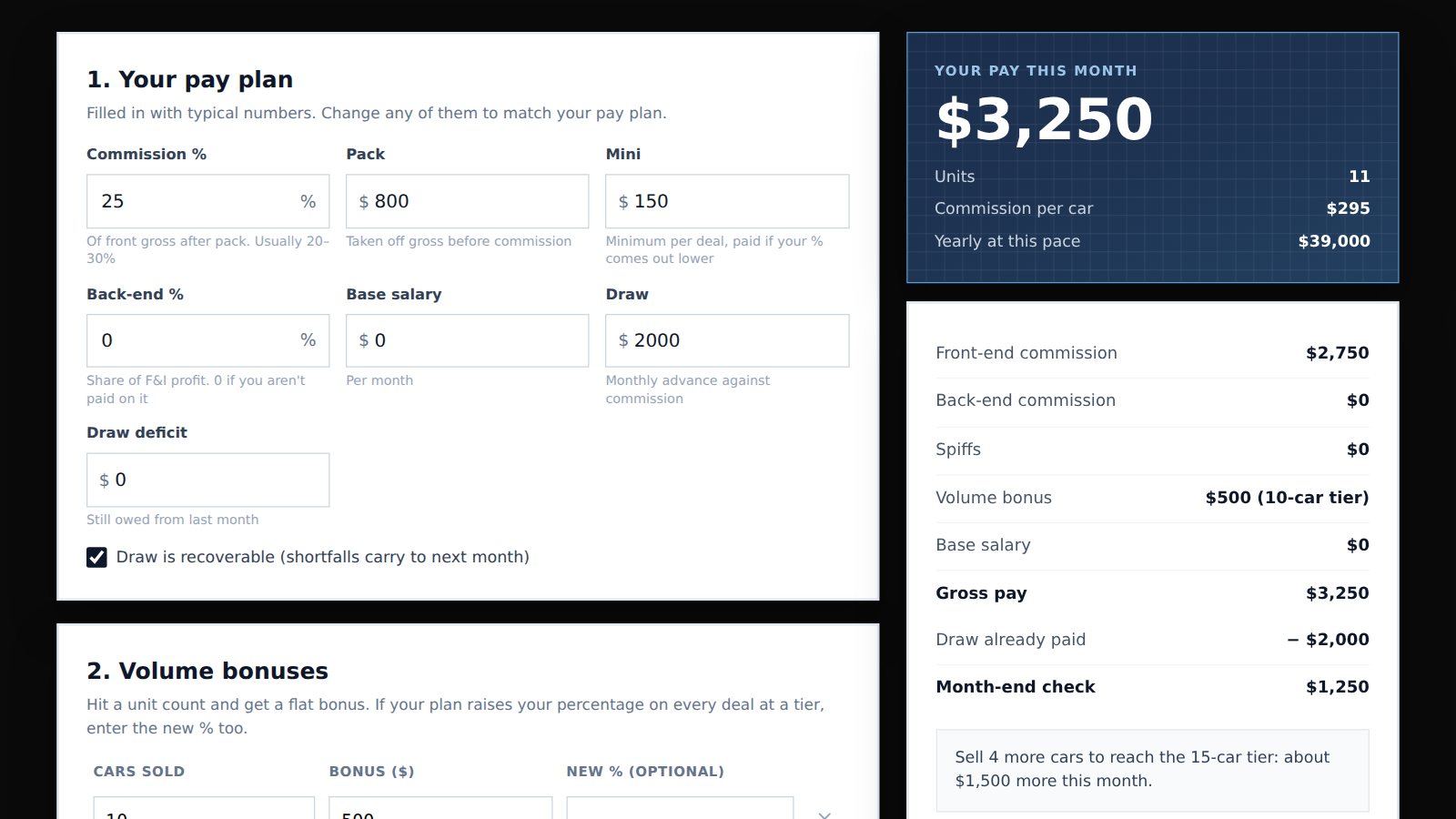
Below is every step worked on real numbers, examples you can reproduce line for line, and the one comparison most reps never run before they sign a pay plan. If you'd rather see your own number than ours, the free car salesman commission calculator runs every step in this article on your plan. Nothing you type is sent anywhere.
What is the formula for car sales commission?
Every example here uses the calculator's starting plan, so you can open it and check any line. That plan is 25% of front gross after an $800 pack, a $150 mini, no back-end and a $2,000 draw, with volume bonuses of $500 at 10 units, $1,000 at 15 and $2,000 at 20. Here is one ordinary deal, step by step.
| Step | Rule | On an $1,800 deal |
|---|---|---|
| 1. Front gross | What the store made on the vehicle itself | $1,800 |
| 2. Minus the pack | A fixed amount the store keeps first. Never below zero | $1,800 − $800 = $1,000 |
| 3. Times your rate | Your percentage of what's left | $1,000 × 25% = $250 |
| 4. Versus the mini | You're paid whichever is higher | $250 beats $150, so $250 |
| 5. Plus back-end | Your percentage of finance-office gross, if your plan pays one | $0 on this plan |
| 6. Plus spiff | Flat money on that unit | $0 |
| 7. Split? | Half the pay and half a unit | Not split: $250 and 1 unit |
| 8. Volume bonus | The highest tier the month reached | Counted at month-end |
| 9. Plus base | Salary, if you have one | $0 on this plan |
| 10. Minus the draw | The advance already paid, plus any deficit carried in | Counted at month-end |
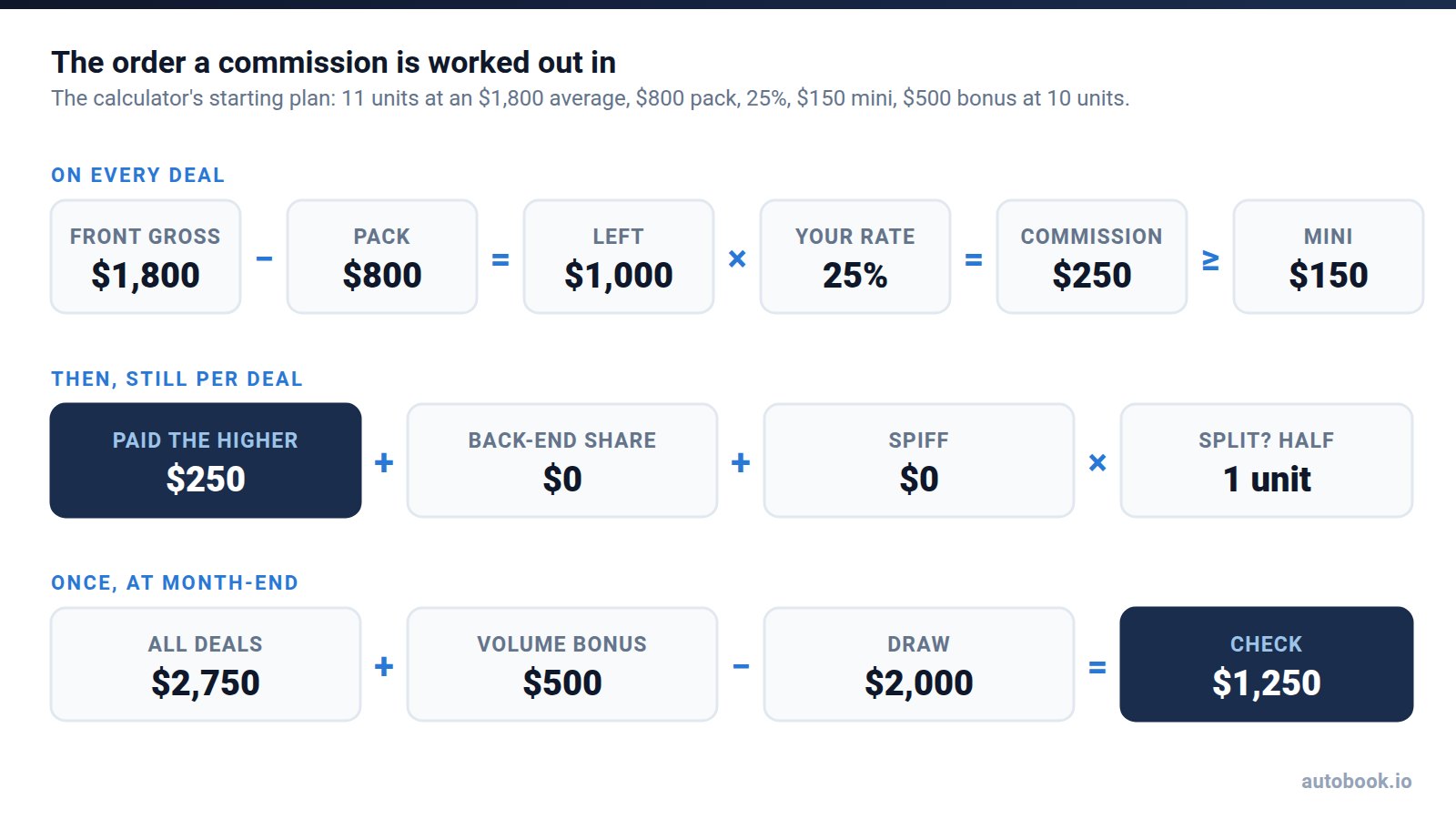
Two lines in that table move more money than your percentage does. The pack comes off before your rate, so a pack that's $200 bigger costs you $50 on every deal at 25%. And the mini isn't a bonus. It's a floor, which means some of the gross you work for never reaches your check at all.
What does a mini deal actually pay?
The mini, whenever your percentage comes out lower. On the starting plan that happens more often than it sounds.
| Front gross | After the pack | At 25% | You're paid |
|---|---|---|---|
| $600 | $0 | $0 | $150, the mini |
| $1,200 | $400 | $100 | $150, the mini |
| $1,400 | $600 | $150 | $150 |
| $1,800 | $1,000 | $250 | $250 |
| $2,400 | $1,600 | $400 | $400 |
Look at the first three rows. A deal that grossed $600 and a deal that grossed $1,400 pay you exactly the same. Every dollar between the pack and pack + (mini ÷ rate), which is $800 to $1,400 on this plan, is gross that changes the store's number and not yours. Call it the mini dead zone.
Work out where yours sits. On a deal headed for the zone, the last few hundred dollars of gross don't pay you anything. On a deal just above it, every $100 is worth $25. The calculator counts how many of your deals paid the mini, so a month heavy with them shows up the moment you enter it.
How do split deals count?
Half the pay and half a unit. Two reps who work the same buyer each get half of what the deal would have paid one of them: $125 each on the $1,800 deal instead of $250.
The half unit is the part people forget. The calculator's starting month is 10 full deals and 2 splits. That's 11 units, not 12, and 11 is the number your volume tiers see.
What does a volume bonus do to the rest of the month?
That depends on which kind you have.
A flat tier adds a fixed amount once you reach it. Those 11 units at an $1,800 average pay $2,750 in front commission, plus the $500 bonus for passing 10. That's $3,250 of gross pay, about $295 a unit once the bonus is spread across the month.
Four more units would reach the 15-unit tier. The four deals pay $1,000 of commission and the bonus steps from $500 to $1,000, so the month rises by $1,500, not $1,000. The calculator prints this under your results: how many units to the next tier, and roughly what reaching it is worth.
A retroactive tier is different, and it's where the biggest single-unit swings in car sales pay live. Hit the number and the new percentage applies to every deal that month, not just the ones after it.
| Month | Rate on every deal | Front commission |
|---|---|---|
| 11 units | 25% | $2,750 |
| 12 units, retro tier reached | 30% | $3,600 |
Same $1,800 average. The 12th unit is worth $850, more than three times its own $250. If that tier also pays a $500 flat bonus, the 12th unit is worth $1,350. That explains the last two days of most months better than anything written about motivation. It's also why you want to know exactly where your retro line sits by the 20th, not the 30th.
To model one in the calculator, add a tier and fill in its New % column. Leave that column empty and the tier is treated as a flat bonus.
How does the draw come off your check?
A draw is an advance against commission you haven't earned yet. At month-end your gross pay is set against it. Earn more and you get the difference as a check. Earn less and, on a recoverable draw, the shortfall follows you into next month.
| Month | Units | Gross pay | Draw | Carried in | Month-end check | Carried out |
|---|---|---|---|---|---|---|
| Normal | 11 | $3,250 | $2,000 | $0 | $1,250 | $0 |
| Short | 5 | $1,250 | $2,000 | $0 | $0 | $750 |
| The month after | 11 | $3,250 | $2,000 | $750 | $500 | $0 |
The third row is where reps get surprised. A normal month, the bonus hits, and the check is $500 because last month's $750 came off first. On a non-recoverable draw that $750 would simply be forgiven, which is why "is the draw recoverable?" belongs on the list of questions you ask before you sign. What a store can and can't claw back, and when, is covered in car salesman pay plans, explained.
Draws exist partly because of how federal law treats this job. Salespeople at car dealerships are exempt from overtime under the Fair Labor Standards Act (29 U.S.C. § 213(b)(10)) but not from minimum wage, so a store paying on commission still has to cover the slow weeks somehow.
Which pay plan pays more: 25% after a $1,000 pack, or 20% after $300?
The stock advice is that the plan with the lower pack always pays more. That's only true when the percentages match. When they don't, the answer depends on your average front gross, and one number settles it:
Break-even gross = (rate A × pack A − rate B × pack B) ÷ (rate A − rate B)
For these two plans: (0.25 × $1,000 − 0.20 × $300) ÷ 0.05 = $3,800. If your average front gross is below $3,800, the 20% plan pays more. Above it, the 25% plan does. Both plans here carry the same $150 mini.
| Front gross | Plan A: 25%, $1,000 pack | Plan B: 20%, $300 pack | Difference per unit |
|---|---|---|---|
| $1,500 | $150 (mini) | $240 | B pays $90 more |
| $2,000 | $250 | $340 | B pays $90 more |
| $2,500 | $375 | $440 | B pays $65 more |
| $3,000 | $500 | $540 | B pays $40 more |
| $3,800 | $700 | $700 | Even |
| $5,000 | $1,000 | $940 | A pays $60 more |
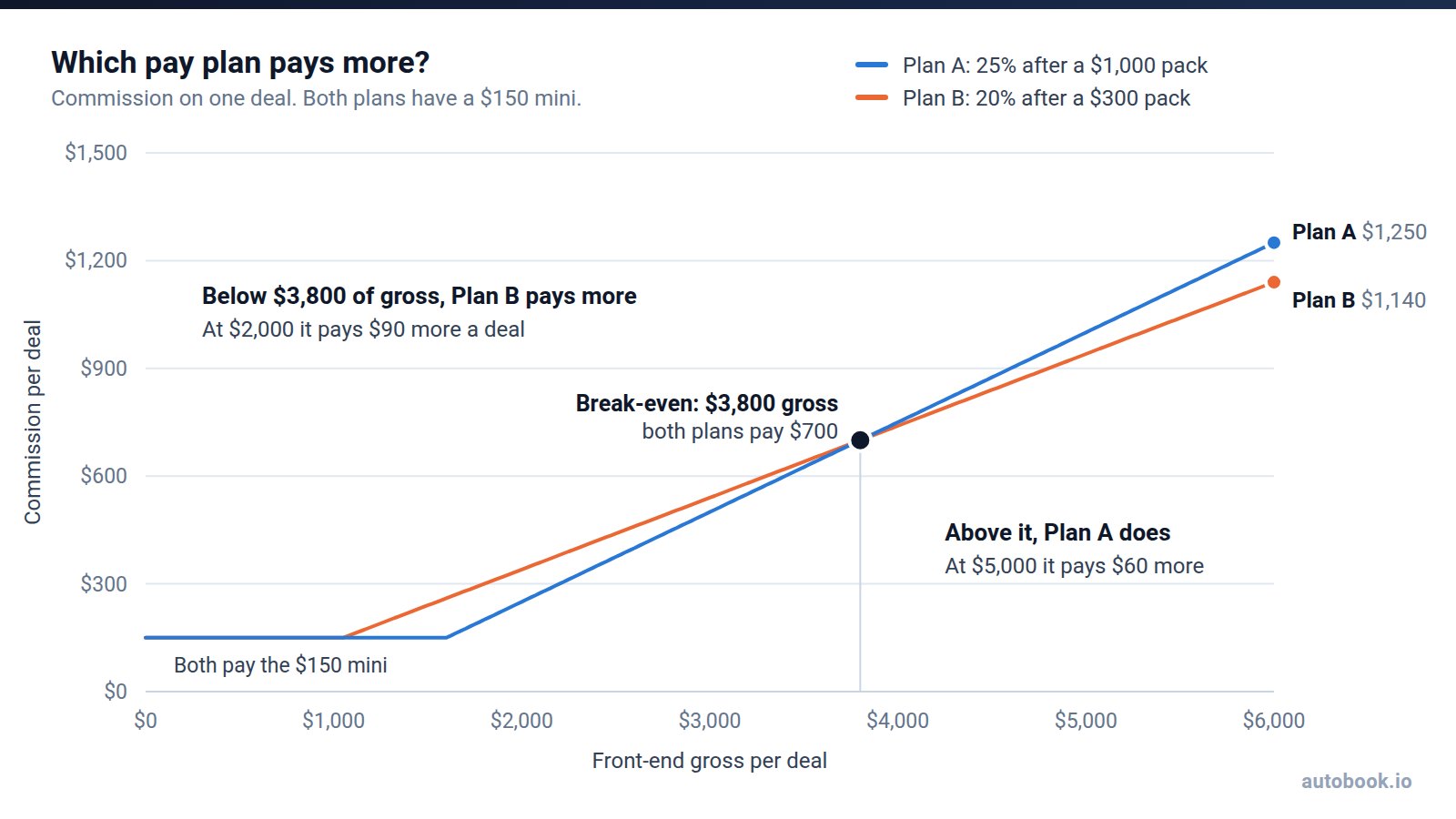
At a $2,000 average, a 12-unit month pays $3,000 on plan A and $4,080 on plan B. The plan with the smaller percentage pays $1,080 more a month. If your store's average sits well under the break-even, the lower pack wins. If you sell units with big front grosses, run the numbers before you assume anything.
To compare two offers in the calculator, enter plan A and press Copy link to my plan. Do the same for plan B. Each link reopens that plan with your month intact, so you can flip between them or send both to someone whose judgment you trust. The pay plan is one line in a bigger decision, and the rest of it is in how to judge a dealership before you take the job.
How do you check your commission sheet?
Switch the calculator to Deal by deal. Enter each deal from your sheet, with its front gross, back-end, spiff and whether it was a split, and compare the totals line by line. The places a sheet most often disagrees with you:
- The pack on each unit. If your store's pack floats with recon or differs between new and used, ask which number came off which deal.
- The minis. Count them. The calculator tells you how many deals paid the mini.
- The splits. Half a unit each, toward the tier as well as the pay.
- The tier. Which one you reached and, if it's retro, whether every deal was re-paid at the new rate or only the ones after it.
- The back-end. Your percentage of which number, and whether it was applied to every deal that had product on it.
- The draw, and anything carried in from last month.
If most of what you want to change is the back-end line, that's usually a different job rather than a different plan. The path from the floor to the finance office is in from the floor to the desk.
What if your pay plan doesn't look like this?
Most do. A few common variations, and how to handle them:
- A flat amount per unit. Set the commission percentage to 0% and the mini to your flat. Every deal then pays the flat, and the calculator will report every deal as a mini, which is expected.
- Leases. The math is the same; the front gross is usually thinner, which pushes more deals into the mini. Why that happens is in commission on a lease.
- Escalators that raise the flat only on units past a threshold, such as $300 a unit and $350 from the 13th. The calculator's tiers pay a bonus or re-rate the whole month, so it can't model this one exactly.
- Chargebacks and taxes. Left out on purpose. A chargeback, when a customer cancels a product and your share comes back off a later check, has to be subtracted by hand. And the result is gross pay, not take-home.
What is one more unit a month worth?
On the starting plan, one unit is $250, and the unit that crosses a tier is worth several times that. The box beneath the calculator's results works out what a few more units a month would pay on your plan, bonus steps included. Working backward from an income goal is the same exercise at a larger scale, and it's done in full in how many cars you have to sell to make $100K.
More units come from more at-bats, and the cheapest at-bats left are buyers already shopping Facebook Marketplace near you. autobook.io imports your dealership's inventory from its website, writes an editable description for every unit, and posts them to Marketplace from your own profile, in your own browser. Posting by hand runs about 13 minutes a vehicle. You still choose the units, answer every buyer and close the deal, and the buyers take real time: roughly 40 minutes a day. It removes the grind, not the job.
Plans start at $99 a month, and across the network about one in nine posted vehicles sells. Esad, at Napleton Buick GMC, put the math more bluntly than we would: "one sale, I make my money for the month."
Frequently asked questions
How do you calculate commission on a car sale?
Subtract the pack from the front-end gross, multiply by your commission percentage, and take the mini if that's higher. Add your share of back-end and any spiff, halve it if the deal was split, then add the month's volume bonus and subtract the draw.
How much commission does a car salesman make per car?
Your pack, rate and average gross decide it, which is why published averages disagree so much. On the calculator's starting plan it's $250 on an $1,800 deal, and about $295 a unit once the 10-unit bonus is spread across the month. Enter your last ten deals to get your real number.
Do split deals count toward volume bonuses?
As half a unit each. Two splits count as one unit toward your tiers, and each pays half the commission.
Is a higher commission percentage always better?
No. A higher rate with a bigger pack only pays more above the break-even gross: (rate A × pack A − rate B × pack B) ÷ (rate A − rate B). For 25% after $1,000 against 20% after $300, that's $3,800 of front gross a unit.
Is the commission calculator free, and does it save my numbers?
It's free and there's no sign-up. Nothing you enter is sent to a server. The link you copy holds your whole plan and month, so the link is the only copy, and you decide who gets it.
Can it handle a flat-per-unit pay plan?
Yes. Set the commission percentage to 0% and the mini to your flat amount, then add your volume tiers as usual.