Do Car Salesmen Get Commission on Holdback?
On many pay plans, no. Commission is figured on front gross, the selling price minus the vehicle's cost as the store defines it, and holdback is money the manufacturer pays the dealer outside that number. Your written plan decides it. On a $1,000 deal paid at 25% after an $800 pack, counting a $1,200 holdback would move the check from $150 to $350.
Search this and you get a forum thread, a car-news explainer, a content farm, a Q&A site, a car-buying site, a compensation vendor, a pricing site and a dealer attorney. Most of it explains holdback to buyers. None of it shows what holdback would do to the number on your commission sheet.
That's this article. Every pay figure comes from the free car salesman commission calculator, which runs one deal or a whole month on your own plan. Holdback isn't a field in it, and that's the point: you find out whether it counts, then enter the front gross your plan actually pays on.
What is dealer holdback?
It's a payment from the manufacturer to the dealer on a new vehicle. Edmunds defines it as a percentage of either the MSRP or the invoice price that the manufacturer repays to the dealer. It describes 2 to 3 percent of MSRP as typical, paid back at set times, usually quarterly.
So the invoice the store is billed includes money it will get back later. That's why a new unit sold at invoice can still earn the store something. The exact percentage, and whether it's figured on MSRP or invoice, depends on the manufacturer.
Holdback applies to new vehicles. A used unit's cost is what the store paid for it, plus whatever it put into it.
Is holdback included in a salesperson's commission?
On many plans, no. Your commission is a percentage of front gross, and front gross is the selling price minus the vehicle's cost. The question is what your store calls cost. On a new unit, if cost is the invoice, the holdback is still sitting inside it, and your gross never sees it.
Other factory money follows the same rule. How much a car salesman makes per car puts it plainly: manufacturer money paid to the store, such as a stair-step program, isn't part of your commission unless your plan says so. Holdback is one more line of it.
There's a practical reason, too. Your commission is figured on the deal when it delivers. Holdback, by Edmunds' account, arrives later, in a lump. A plan that paid you on it would be paying on money the store hasn't received yet.
We can't tell you how common each kind of plan is. Nobody publishes that. What we can tell you is what to look for, and what it's worth.
What would counting holdback change on one deal?
Here's a new unit with a $40,000 MSRP and a 3% holdback, so $1,200, at four different front grosses. The plan is the calculator's starting plan: 25% of front gross after an $800 pack, with a $150 mini. The deal numbers are illustrations.
| Front gross against invoice | Paid without holdback | Front gross with holdback counted | Paid with holdback | Difference |
|---|---|---|---|---|
| $0, sold at invoice | $150, the mini | $1,200 | $150, the mini | $0 |
| $1,000 | $150, the mini | $2,200 | $350 | $200 |
| $1,800 | $250 | $3,000 | $550 | $300 |
| $2,500 | $425 | $3,700 | $725 | $300 |
Two things stand out. First, the deal sold at invoice pays the same mini either way. On this plan, any deal up to $1,400 of front gross pays the $150 mini, and $1,200 of holdback doesn't clear that on its own.
Second, once a deal is above the mini, counting holdback is worth 25% of it on every unit: $300 here. That's real money on a new-car plan, where thin deals are common.
And on a month?
Here's a 12-unit month of new deals on the same plan, with its starting volume bonus of $500 at 10 units. Front grosses against invoice: $0, $500, $800, $1,000, $1,200, $1,500, $1,800, $2,000, $2,200, $2,500, $3,000 and $3,500.
| 12 new units | Holdback not counted | $1,200 holdback counted on each |
|---|---|---|
| Front commission | $3,475 | $6,250 |
| Deals paid at the mini | 5 | 1 |
| Volume bonus | $500 | $500 |
| Month's commission | $3,975 | $6,750 |
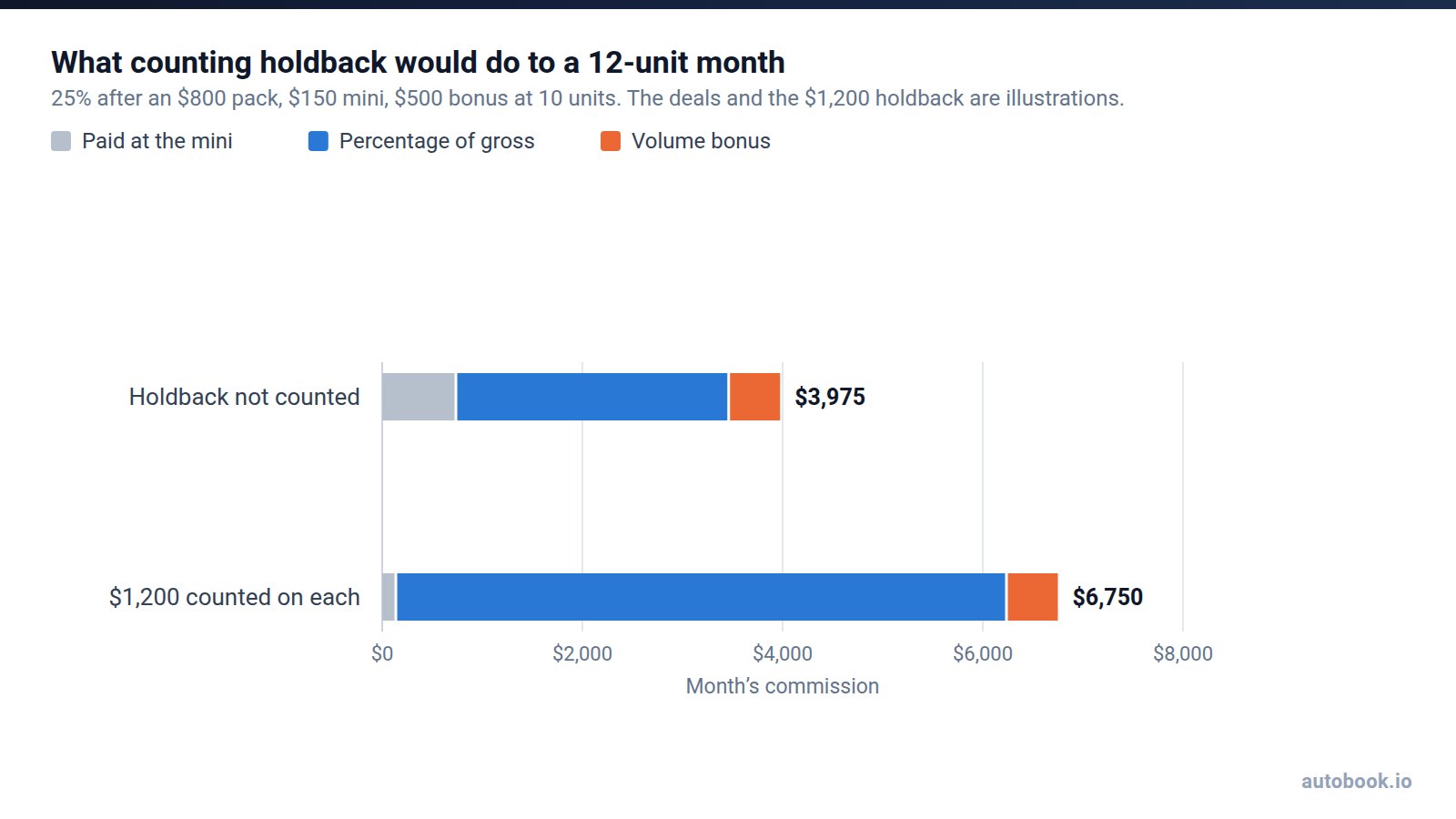
The same twelve deals pay $2,775 more if holdback counts. That's what one sentence in your pay plan can be worth, and why it's worth finding.
If your store's plan pays on holdback, or on part of it, the calculator still works. Add the counted amount to each deal's front gross in the Deal by deal tab and the results follow.
What sentence should you look for in your pay plan?
The definition of front gross. It's often one line, and everything on your check depends on it. Here's what to ask, in order:
- What is "cost" on a new unit? Invoice, invoice less holdback, or something else.
- What's added to cost before gross is figured? The pack, and anything else, such as prep or advertising charges. Each one comes off your gross.
- Which factory money counts? Holdback, dealer cash, stair-step and other incentive money paid to the store. If the plan names none of them, ask whether none of them count.
- Which spiffs are yours? A manufacturer spiff passed through to you is separate, flat money on the unit. It goes on the spiff line.
You can also check one deal against the recap. It shows the selling price, the cost the store used and anything added to it. If the cost line on a new unit matches the invoice, the holdback is still inside the cost, and your gross was figured without it. If it's lower than the invoice by about the holdback, your plan is counting it.
If the answer to any of these is "it depends", ask for it in writing. How to check a commission sheet line by line is in how to calculate car sales commission. The pack, and how much of the deal it takes before you're paid anything, is in car salesman pay plans, explained.
One thing this article isn't. It's about reading your own pay. What the store tells a buyer about its cost is the desk's business, and nothing here is a negotiating script for either side.
Where does a new-car rep's pay come from, then?
From the parts of the plan that do pay you: the percentage of front gross, the mini on thin deals, spiffs passed through, and the volume bonus. On a new-car plan, the floor and the count can be most of the month. A worked comparison of a new-car plan and a used-car plan is in do car salesmen make more on new or used cars.
Holdback isn't yours to move. The count is. On the plan above, every extra unit is at least a $150 mini, and the tenth unit also brings the $500 bonus.
More units come from more buyers, and a lot of them are shopping Facebook Marketplace near you. autobook.io imports your dealership's inventory from its website and writes an editable description for each unit. It posts them to Marketplace from your own profile, in your own browser, in batches of up to 50. Posting a vehicle by hand takes 10 to 15 minutes. You still choose the units, answer every buyer in Messenger and close, and the buyers take roughly 40 minutes a day. It removes the grind, not the job. Plans start from $99/month, and across the network about one in nine posted vehicles sells.
Then enter each deal, at the gross your plan really pays on, in the calculator's Deal by deal tab.
Frequently asked questions
Do car salesmen know the holdback on a car?
Some do and some don't, and it rarely matters to the check. If your plan figures gross against invoice, the holdback isn't in your number whether you know it or not.
Is holdback paid on used cars?
No. Holdback is a manufacturer payment on new vehicles. A used unit's gross is the selling price minus what the store has in it.
Can I ask for holdback in my pay plan?
You can ask, and if the store agrees, get it in writing. The more useful questions are what "cost" means and which spiffs are yours.
Why does my commission sheet show less gross than I figured?
Check the pack first, then any other charge added to cost before gross is figured. Ask for the deal recap, which shows the selling price, the cost and everything taken out between them.
Does dealer cash count toward my commission?
Only if the plan says so. Dealer cash is factory money paid to the store, like holdback. Find the sentence that defines front gross and see which incentives it names.