Car Sales Volume Bonus: What the Next Unit Is Worth
A car sales volume bonus is money for reaching a unit count. A flat bonus adds a fixed sum. A retro bonus raises your pay on every deal that month. The unit that crosses the line earns its commission plus the jump. On $1,800 deals at 25% after an $800 pack, a $500 bonus at 10 makes the 10th unit worth $750, not $250.
The pages that rank for this search mostly give you tier ranges: a bonus at 10 units, a bigger one at 15. None we found works out what the unit that crosses a tier is worth. That's the only number you need on the 28th of the month, with two deals still in play.
This article works it out on a flat grid and a retro one, with split deals at the line. Every figure comes from the free car salesman commission calculator, on its starting plan. That's 25% of front gross after an $800 pack, a $150 mini, and bonuses of $500 at 10 units, $1,000 at 15 and $2,000 at 20. Unless a table says otherwise, every deal has $1,800 of front gross, so each one pays $250 on its own.
What is a volume bonus in car sales?
Money for the count, not the deal. Your plan sets unit counts, called tiers, and pays something when the month reaches one. There are two kinds, and they behave very differently at the line.
- Flat. A fixed sum at each tier. On the starting plan, reaching 15 units replaces the $500 with $1,000. It doesn't add to it.
- Retro. Reaching the tier raises your pay on every deal that month, back to the first. It can be a higher percentage or an amount per unit. This article uses the percentage.
Spiffs and the rest of the unit money on a plan are covered in car salesman pay plans, explained. This article is only about the count.
What is a 10-car bonus worth?
On the starting plan, $500. The 10th unit is worth more than that.
| Units this month | Pay for the month | What that unit added |
|---|---|---|
| 8 | $2,000 | $250 |
| 9 | $2,250 | $250 |
| 10 | $3,000 | $750 |
| 11 | $3,250 | $250 |
| 14 | $4,000 | $250 |
| 15 | $4,750 | $750 |
| 16 | $5,000 | $250 |
| 19 | $5,750 | $250 |
| 20 | $7,000 | $1,250 |
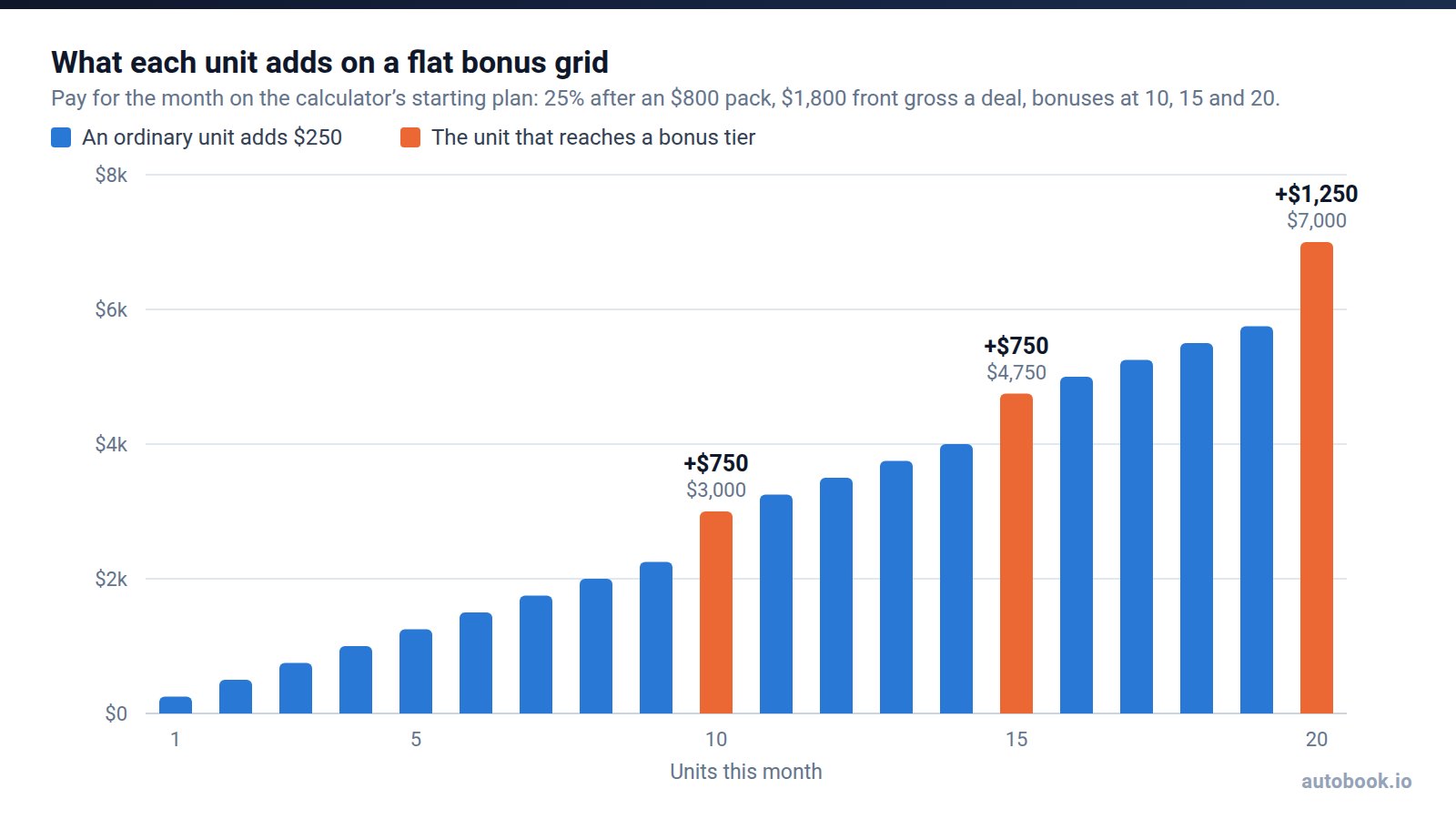
Three units in the month are worth more than their own commission. The 10th and 15th are worth $750 each. The 20th is worth $1,250, because the bonus steps from $1,000 to $2,000. The other 17 are worth $250 apiece.
The draw makes the jump show on the check even more. With the starting plan's $2,000 draw, 9 units leave a $250 month-end check. The 10th unit takes it to $1,000.
How is a retro bonus different?
A flat bonus is the same sum however the month went before it. A retro tier re-pays every deal already on the board, so the unit that crosses it is worth more when those deals carried more gross. Here is the starting plan's flat grid next to a retro grid that pays 25% until 12 units and 30% on every deal from there:
| Units | Flat grid: month | Flat grid: that unit | Retro grid: month | Retro grid: that unit |
|---|---|---|---|---|
| 9 | $2,250 | $250 | $2,250 | $250 |
| 10 | $3,000 | $750 | $2,500 | $250 |
| 11 | $3,250 | $250 | $2,750 | $250 |
| 12 | $3,500 | $250 | $3,600 | $850 |
| 13 | $3,750 | $250 | $3,900 | $300 |
| 14 | $4,000 | $250 | $4,200 | $300 |
| 15 | $4,750 | $750 | $4,500 | $300 |
| 16 | $5,000 | $250 | $4,800 | $300 |
On the retro grid, the 12th unit is worth $850, more than three times its own $250, because it re-pays the 11 before it at 30%. Every unit after it pays $300 instead of $250. If the retro tier also paid a $500 flat bonus, the 12th unit would be worth $1,350. Those match the worked example in how to calculate car sales commission, which covers the rest of the commission sheet.
Neither grid wins everywhere. From 12 to 14 units the retro grid pays more. At 15 and 16, the flat grid's $1,000 bonus puts it back in front. So compare grids at the months you actually have, not at one number. Six whole plans run through the same months are in car salesman pay plan examples.
Which pays you more, a flat bonus or a retro tier?
That depends on your gross, and by a lot. Take one tier at 12 units and two ways to pay it: a flat $500, or 25% becoming 30% on every deal. Here's what the 12th unit is worth at four average grosses:
| Front gross on every deal | 12th unit, flat $500 at 12 | 12th unit, retro 25% to 30% at 12 |
|---|---|---|
| $1,200 | $650 | $150 |
| $1,800 | $750 | $850 |
| $2,500 | $925 | $1,445 |
| $3,500 | $1,175 | $2,295 |
Look at the first row. At $1,200 every deal pays the $150 mini, at 25% or at 30%, so the retro tier adds nothing. The 12th unit is worth its own mini and no more. A flat bonus pays the mini-heavy rep the same $500 it pays everyone.
Now the last row. At $3,500 the 12th unit is worth nearly twice as much on the retro tier. That's the whole pattern. A flat grid rewards the count. A retro grid rewards the count and the gross together. If you hold gross, a retro tier is worth chasing. If most of your month is minis, a retro percentage is a number on paper.
Do split deals count toward a volume bonus?
The calculator counts each split as half a unit. Your plan may count it differently, so check. At half a unit each, half a deal is the difference more often than you'd think.
Say you have 9 full deals and one split: 9.5 units, $2,375, no bonus. Another split takes you to 10 units and $3,000. That half deal is worth $625: its own $125 plus the $500 bonus. A full deal instead would take you to 10.5 units and $3,125.
It happens again at the next line. At 14.5 units, one more split is worth $625, because the bonus steps from $500 to $1,000. That's five times the split's own commission. And from 9 units, two splits get you to exactly the same $3,000 as one full deal.
One quirk: the calculator's next-tier note rounds up. At 9.5 units it tells you to sell 1 more car to reach the 10-unit tier. Half of one will do.
What is the last unit of the month worth?
Whatever the calculator prints under your results, and it's worth checking before the last week, not during it. Enter your month so far and it shows how many units stand between you and the next tier, and roughly what reaching it pays. At 13 units on the starting plan, that's 2 units to the 15-unit tier, for about $1,000: $500 of commission and a $500 step in the bonus.
The box beneath it goes a step further. Enter a number of extra units a month and it shows what they'd pay on your plan, bonus steps included.
That's the arithmetic behind the end of most months. The same $1,800 deal is worth $250 as your 12th unit and $750 as your 15th. Where it lands decides that, not what it grosses. So know your count and your next line by the 20th, when there's still time to do something about it.
What does a bonus do to your commission per car?
It inflates it, which matters when you compare months or offers. The calculator's commission-per-car figure divides everything, bonus included, by your units. On identical $1,800 deals it reads:
| Units | Commission per car |
|---|---|
| 9 | $250 |
| 10 | $300 |
| 14 | $286 |
| 15 | $317 |
| 19 | $303 |
| 20 | $350 |
Same deals, same gross, and the per-car figure swings by $100. When someone quotes you an average per car, ask whether a bonus month is inside it. When you compare your own months, look at the deals and the bonus separately.
Is your volume bonus the same as the store's stair-step?
No. A manufacturer's stair-step program pays the dealership for hitting the store's own volume targets. That money goes to the store, and it isn't part of your pay plan unless the plan says so. You feel it indirectly: a store close to its target may take a thinner deal at month-end to get there. How that plays out across the year is in the best and worst months for car sales.
What should the written plan say about the bonus?
These questions decide what the tables above are worth to you. Ask them before the month you need the answers:
- Is each tier flat or retro? If retro, does it re-pay every deal from the first, or only the deals after the line?
- Does a higher tier replace the lower bonus, or add to it? The calculator pays the highest tier reached. If yours stack, enter each tier's bonus as the running total.
- How does a split count toward the tier: half a unit, a whole one, or not at all?
- When does a unit count: on delivery, or when the deal funds? A unit delivered on the 31st and funded on the 3rd can land in the wrong month.
- Do house deals and manager turnovers count toward your tier?
- Does an unwind after payday take the unit back off the count?
How do you reach the next tier more often?
Every table here says the same thing: the unit that crosses a line pays several times what an ordinary one does. Put your own grid into the commission calculator, with a New % wherever your plan is retro, and see which unit is the expensive one this month.
Getting there is a count problem, and the count comes from buyers. The cheapest ones left are already shopping Facebook Marketplace near you. autobook.io imports your dealership's inventory from its website and writes an editable description for each unit. It posts them to Marketplace from your own profile, in your own browser, in batches of up to 50, and renews listings. Posting a vehicle by hand takes 10 to 15 minutes. You still choose the units, answer every buyer in Messenger and close. The messages alone run roughly 40 minutes a day. It removes the grind, not the job. Plans start from $99/month, and across the network about one in nine posted vehicles sells. The longer case is in getting buyers of your own.
Frequently asked questions
What is a 10-car bonus?
A flat bonus paid when you reach 10 units in a month. On the calculator's starting plan it's $500, which makes the 10th unit worth $750 on a deal with $1,800 of front gross.
Is a retro bonus better than a flat one?
When your deals carry gross, it can be. At $1,200 of front gross every deal pays the mini, so a 25%-to-30% retro tier at 12 adds nothing. At $3,500 the same tier makes the 12th unit worth $2,295, against $1,175 for a flat $500.
Do volume bonuses stack as you move up tiers?
That depends on your plan, so ask. The calculator pays the highest tier reached, so $1,000 at 15 units, not $1,500. If your plan adds them together, enter each tier as the running total.
Why was 22% taken out of my bonus?
A bonus paid separately from regular pay counts as supplemental wages, and IRS Publication 15 lets your employer withhold federal income tax on it at a flat 22%. That's withholding, not your final tax, which settles when you file.
Can the calculator handle a retro tier?
Yes. Add a tier and fill in its New % column, and once you reach that tier every deal that month is re-paid at the new rate. Leave the column empty and the tier is a flat bonus.
Does a split deal get me to the next tier?
In the calculator a split counts as half a unit, so at 9.5 units one more split reaches 10. On the starting plan it's worth $625: $125 of commission plus the $500 bonus.