
Do Car Salesmen Get Paid If They Don't Sell?
Yes, something. Federal minimum wage still applies to dealership salespeople, because the FLSA exemption written for them covers overtime only. On a commission plan, a slow month is often paid through a draw: an advance against commission you haven't earned yet. If the draw is recoverable, whatever you didn't earn comes out of your next good month. State law can add to this.
The law sets the floor and the draw fills the month. Neither is what catches people out. What catches them is the month after: a normal month, bonus and all, that pays a small check or none, because the slow one is being paid back.
Every commission and draw figure below comes from the free car salesman commission calculator on its starting plan, so you can open it and swap in your own numbers. It runs in your browser, and nothing you type is sent anywhere.
What does the law guarantee you in a month with no deals?
Minimum wage, for every hour you work. The federal rate is $7.25 an hour. Many states set a higher one, and when both apply you're owed the higher of the two.
The overtime exemption is where reps get it wrong. Federal law exempts "any salesman, partsman, or mechanic primarily engaged in selling or servicing automobiles, trucks, or farm implements" at a dealership from overtime, under 29 U.S.C. § 213(b)(10)(A). The Labor Department's own regulation calls it "a specific exemption from only the overtime pay provisions" of the Act (29 CFR 779.372).
Only overtime. A 55-hour week earns no time-and-a-half, but the minimum-wage rule still reaches all 55 hours.
Two more details decide how that plays out. First, minimum wage is measured one week at a time, so a dead week can't be averaged against a good one. The Labor Department's Handy Reference Guide to the FLSA says "each workweek stands alone; there can be no averaging of 2 or more workweeks."
Second, the law's reach. The department's fact sheet for auto dealers says it covers every employee of a dealership with at least $500,000 a year in gross sales. It can reach smaller stores too.
What that floor comes to on a real schedule, hours times the rate, is worked out in how many hours car salesmen actually work. Your state can add rules on top, including how a commission plan has to be written down. That comes up below.
Is a draw a paycheck or a loan?
Somewhere in between. The Labor Department defines it in a fact sheet on commission-paid retail employees. A draw is "a fixed sum of money paid in advance of the settlement date for the earned commission pay" (Fact Sheet #20). Put plainly, it's your own commission, paid early.
At month-end your commission is set against it. Earn more than the draw and you get the difference as a check. Earn less and, on a recoverable draw, the shortfall follows you into next month as a deficit. On a non-recoverable draw it's forgiven.
Where the draw sits beside the pack, the mini and the volume bonus is in how to calculate car sales commission. The plan definitions are in car salesman pay plans, explained.
The calculator models all of this with three fields under Your pay plan:
- Draw. The monthly advance. The starting plan uses $2,000.
- Draw deficit. What's still owed from last month. Leave it at $0 unless last month came up short.
- Draw is recoverable. Ticked if shortfalls carry into next month. Unticked if they're forgiven.
When a month comes up short, the results say so in one line: "Commission didn't cover the draw. $1,050 carries into next month." That number goes into Draw deficit when you run the next month. The Draw already paid line then shows both together, − $3,050 on a $2,000 draw with $1,050 carried in.
What happens if you don't sell a car in a month?
You're paid the draw, and you owe all of it back. Here's a month with zero units on the starting plan: 25% after an $800 pack, a $150 mini, a $2,000 recoverable draw and a $500 bonus at 10 units. Then come two ordinary months of 10 full deals and 2 splits at $1,800 of front gross, which is 11 units.
| Month | Gross pay | Deficit carried in | Month-end check | You took home | Deficit carried out |
|---|---|---|---|---|---|
| 1: nothing sold | $0 | $0 | $0 | $2,000 | $2,000 |
| 2: 11 units | $3,250 | $2,000 | $0 | $2,000 | $750 |
| 3: 11 units | $3,250 | $750 | $500 | $2,500 | $0 |
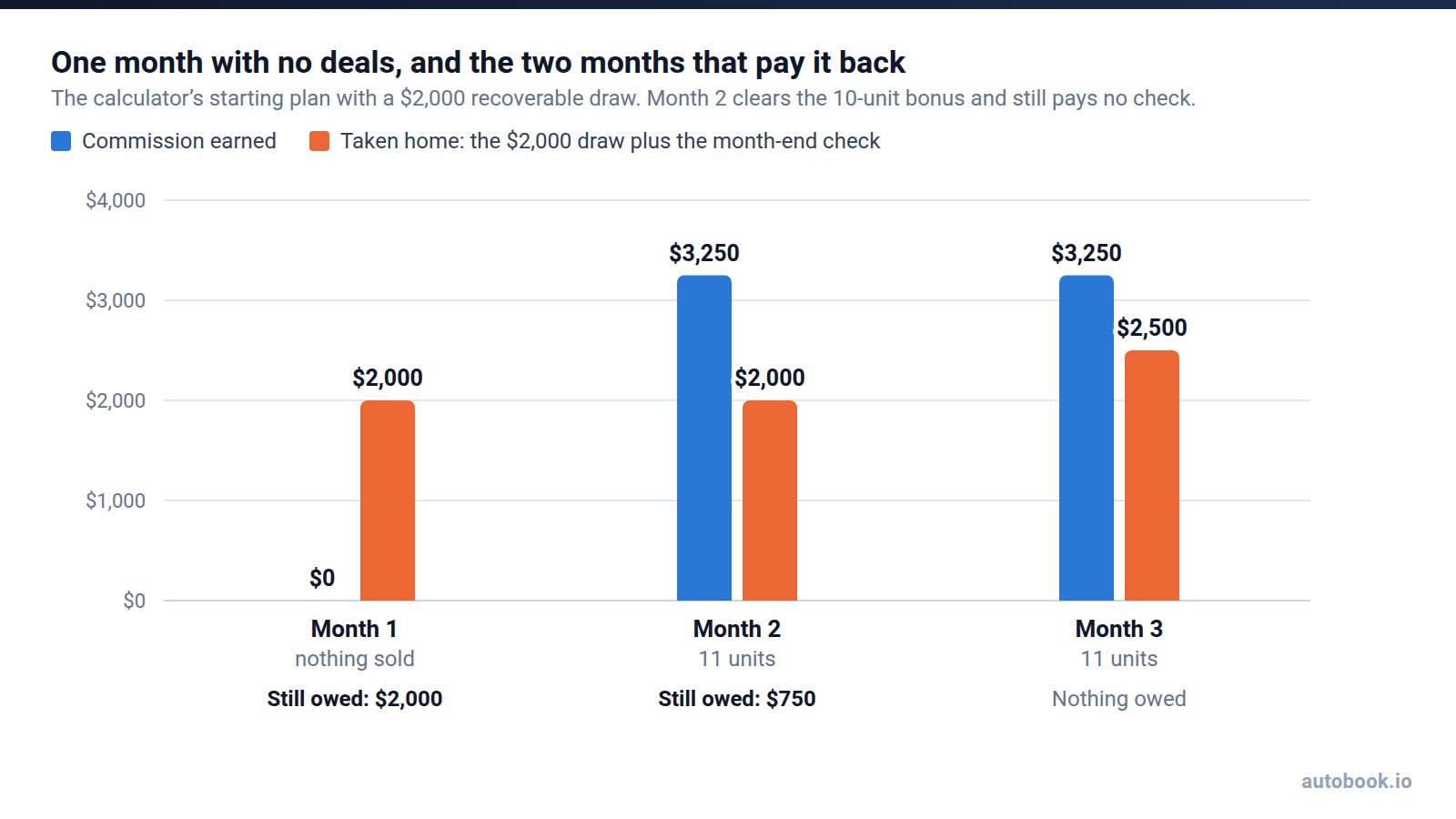
One empty month reaches into the next two checks. Month 2 cleared the 10-unit bonus and still paid nothing above the draw. Month 3 paid $500 instead of the usual $1,250.
Now add up the columns. Over three months you took home $6,500 and earned $6,500. A recoverable draw doesn't add money to your year. It moves some of it earlier, which in a zero month is the whole point.
Recoverable or non-recoverable: what's the difference worth?
A zero month is the extreme case. A slow month is the common one, so here's one: four deals at $1,800, $1,200, $2,400 and $900 of front gross. Two of them pay the $150 mini, and the month earns $950 against the $2,000 draw. Two normal 11-unit months follow.
It's the same plan run twice, once with Draw is recoverable ticked and once without.
| Month | Gross pay | Recoverable: check | Recoverable: deficit carried out | Non-recoverable: check |
|---|---|---|---|---|
| Slow month, 4 units | $950 | $0 | $1,050 | $0 |
| Month 2, 11 units | $3,250 | $200 | $0 | $1,250 |
| Month 3, 11 units | $3,250 | $1,250 | $0 | $1,250 |
| Three months, draw plus checks | $7,450 earned | $7,450 | $8,500 |
The slow month looks the same either way: $2,000 lands and no check comes. The difference shows up a month later, as a $200 check instead of $1,250. Across the three months it's $1,050, exactly the shortfall. On one plan you pay it back. On the other, the store absorbs it.
Two slow months in a row is where a recoverable draw really bites. Run that same slow month twice and the deficit reaches $2,100. The normal month after it pays no check at all and still carries $850 forward. The one after that pays $400.
Which kind you have should be in the written plan. If it isn't, get the answer in writing before you need it.
What happens to a draw balance if you quit or get let go?
It depends on your written plan and your state's law. We won't guess at either for your store, and nobody on the floor should either.
What the calculator gives you is the size of the number. On a recoverable draw, leave after the slow month above and there's $1,050 on the books. Leave after the zero month and it's $2,000. A federal appeals court has ruled on one store's policy for collecting a balance after an employee left, and the pay plan breakdown covers what it said. If you think that conversation is coming, getting fired for not selling enough covers the timing.
Before you sign, get these answered in writing:
- Is the draw recoverable, and does the balance ever reset?
- If I leave owing a balance, what does the plan say happens to it?
- Is there a cap on how large the balance can get?
- Do chargebacks add to the balance, or come off a later check?
Some states require the plan itself in writing. California's Labor Code section 2751 requires a commission contract to be in writing. It "shall set forth the method by which the commissions shall be computed and paid," and you get a signed copy. Other states set their own rules. None of this is legal advice, and if a balance turns into a dispute, your state labor agency is the place to ask.
Where does a slow month actually come from?
Units are opportunities times your closing rate. In a slow month it's usually the first number that dried up, not the second. You didn't forget how to close. The floor stopped handing you people to close.
The deficit math rewards every unit you add. On the starting plan an $1,800 deal pays $250, so each one in a slow month takes $250 off what you'll owe. Five units instead of four leaves $800 to carry, not $1,050.
The cheapest at-bats you can build without waiting on the floor are buyers already shopping Facebook Marketplace near you, from your own profile. Say in the listing that you're a salesperson. Those buyers take time to turn into units. In our study of 802 units that dealers using autobook.io sold, the median was 18.0 days from the most recent post, and 65.2% sold within 30 days. The clock starts at the most recent post, so a repost resets it and every figure is a floor. Buyers you start in a slow month pay out over the weeks after it, which is when the deficit comes due.
Posting by hand takes 10 to 15 minutes a vehicle, and that's the part autobook.io takes off your evening. It imports your dealership's inventory from its website and writes an editable description for each unit. Then it posts to Marketplace from your own profile, in your own Chrome browser, in batches of up to 50. It can renew listings and cross-post to Facebook groups you pick. You still choose the units, answer every buyer in Messenger and close. That's roughly 40 minutes a day, and it stays yours. It removes the grind, not the job.
Plans from $99/month, and across the network about one in nine posted vehicles sells. Before your next slow month, open the commission calculator, enter your own plan and run a month with no deals. The carry line is what you'd owe.
Frequently asked questions
Do car salesmen get paid hourly?
Some plans pay a base salary or an hourly wage alongside commission, and many pay commission against a draw instead. Either way, federal law measures your pay against the hours you worked, one week at a time. How a salary-plus-commission plan compares with other shapes over the same month is in car salesman pay plan examples.
Is a draw the same as a salary?
No. A salary is yours whatever you sell. A recoverable draw is an advance against your own commission, and whatever you don't earn back follows you into the next month. The calculator has a separate Base salary field for the first kind.
How long does it take to pay back a draw deficit?
As long as your commission above the draw takes to cover it. On the starting plan, a normal 11-unit month earns $1,250 over the $2,000 draw, so a $1,050 deficit clears in one month and a $2,000 deficit takes two.
Can a dealership pay a salesperson less than minimum wage in a bad week?
Not under federal law, where the law covers the store. The dealership exemption removes overtime, not minimum wage, and the Labor Department measures minimum wage week by week. If a week's pay came in under the minimum for your hours, take it to your state labor agency.
What if my pay plan has no draw at all?
Then a slow month pays the commission you earned, and federal law still requires at least minimum wage for your hours. Set Draw to $0 in the calculator and the month-end check equals your gross pay.