Car Sales Commission Chargebacks: What Comes Back
A commission chargeback is pay the store takes back after a deal it paid you on goes wrong. The deal unwinds, the financing never funds, or the buyer cancels a service contract or GAP early. Depending on your plan, it comes off a later commission check or adds to a draw deficit. Your written plan sets the rules, and federal and state wage law can limit them.
A negative line on your commission sheet is the store saying a deal you were paid on didn't stay done. Some of those lines are small. One kind can cost more than the deal ever paid you.
Every pay figure below comes from the free car salesman commission calculator on its starting plan, unless a line says otherwise. That's 25% of front gross after an $800 pack, a $150 mini, a $2,000 recoverable draw, and bonuses of $500 at 10 units, $1,000 at 15 and $2,000 at 20. How those lines combine on one deal is in how to calculate car sales commission. The calculator doesn't model chargebacks. It has one field that handles them anyway, and it comes up below.
What gets charged back on a car deal?
Anything your plan paid you on a deal that later came apart. From your side of the desk, it comes in four shapes.
- The deal unwinds. The buyer brings it back, or a delivered deal falls apart after the fact.
- The deal doesn't fund. The buyer took delivery before the financing was final, and the lender never bought the contract.
- A product is cancelled. The buyer cancels a service contract, GAP or a maintenance plan early, or pays the loan off early, and gets back the unused part. The store's profit on that product shrinks, and so does your share of it.
- A spiff is clawed back. The unit that earned it unwound, or didn't qualify after all.
The first two can take the whole deal back: front end, back end and any spiff on it. The third is back-end only, money the finance office made. How plans pay on each end is in car salesman pay plans, explained.
Here's what each one takes back, one deal at a time.
| Chargeback | What the deal paid you | What comes back |
|---|---|---|
| Unwind of an $1,800 deal | $250 | $250 |
| Unwind of a $1,200 deal that paid the mini | $150 | $150 |
| Unwind of a split deal at $1,800 | $125 each | $125 each, if the plan splits it like the pay. |
| A $200 spiff on an $1,800 deal | $450 with the spiff | $200 if only the spiff comes back. All $450 if the deal unwinds. |
| A cancellation cuts back-end gross from $1,500 to $900, on a plan paying 10% of back-end | $150 on the back end | $60 |
Look at the mini row. A deal that paid you the floor still comes back at the floor. And look at the last one. If your plan pays you nothing on the back end, ask why a product cancellation would reach your check at all. If it pays a share, ask exactly what share of a cancellation you carry.
Why can one unwind cost more than the deal paid?
Because the unit can take a bonus with it.
Say last month you sold exactly 10 units at $1,800 and cleared the $500 tier. That's $3,000 of gross pay. One deal unwinds. At 9 units the same month would have paid $2,250. If your plan re-figures the month without that unit, the chargeback isn't $250. It's $750.
| Last month | Units | Gross pay | Chargeback if the month is re-figured |
|---|---|---|---|
| As paid | 10 | $3,000 | None |
| After one unwind | 9 | $2,250 | $750 |
| As paid | 11 | $3,250 | None |
| After two unwinds | 9 | $2,250 | $1,000 |
Not every plan re-figures the month. Some take back the deal's own commission and leave the tier alone. On the first pair of rows, that one sentence in the plan is worth $500. Find out which kind you have before a deal at the tier line starts to wobble.
How does a chargeback come off your check?
The plan decides. It can show up as its own negative line on the next commission sheet. It can come off the month-end check along with the draw. Or, when the check can't cover it, it can sit as a deficit that follows you into the next month. Either way, the month-end check is what shrinks.
In the calculator, the Draw deficit field, labelled "Still owed from last month," is where a chargeback goes. Here's the calculator's normal month with chargebacks of different sizes entered there. It's 10 full deals and 2 splits at $1,800, which is 11 units.
| Chargeback entered as Draw deficit | Gross pay | Month-end check | Carried into next month |
|---|---|---|---|
| $0 | $3,250 | $1,250 | $0 |
| $250, one unwind | $3,250 | $1,000 | $0 |
| $750, an unwind that cost a tier | $3,250 | $500 | $0 |
| $1,000, two unwinds that cost a tier | $3,250 | $250 | $0 |
| $1,500 | $3,250 | $0 | $250 |
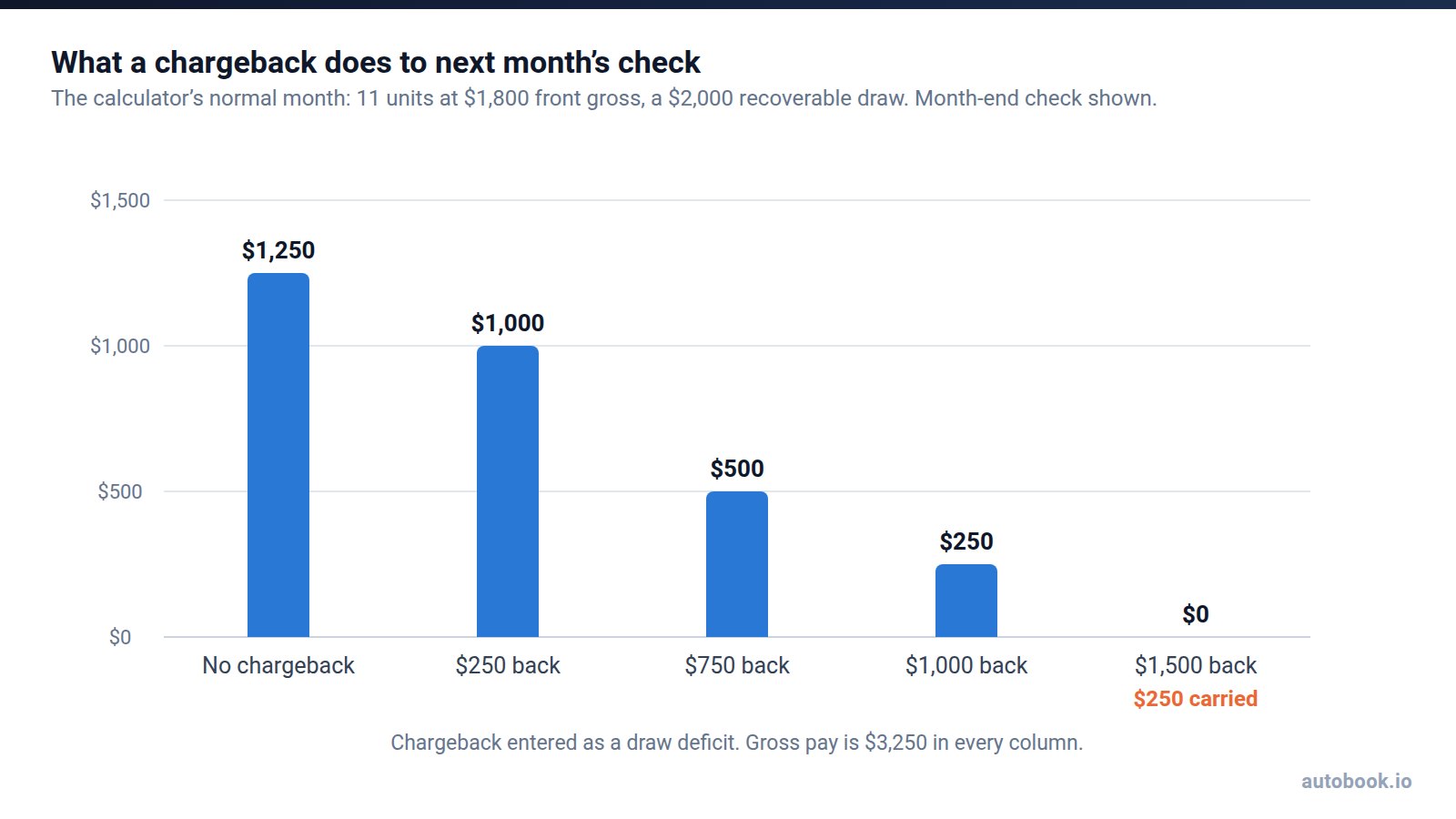
Gross pay doesn't move. The chargeback comes out of the check, and when the check runs out, the rest carries.
Two cautions when you enter one. Type the amount as a plain number: 250, not −250. The math ignores a negative. And leave Draw is recoverable ticked. Untick it and the calculator forgives whatever the check can't cover. That's how a non-recoverable draw works, and it isn't necessarily how your store treats a chargeback. On the $1,500 row, unticking the box makes the $250 carry disappear.
A chargeback in a slow month stacks on top of the draw deficit. Take four deals at $1,800, $1,200, $2,400 and $900 of front gross. They earn $950 against the $2,000 draw, so $1,050 carries. Add a $250 chargeback and $1,300 carries. The normal 11-unit month after that pays no check at all and still carries $50. How a deficit clears, and what a recoverable draw is, is in do car salesmen get paid if they don't sell.
A chargeback has a tax side too, and it's covered in how car sales commission is taxed.
Why do back-end chargebacks arrive months later?
Because the buyer's clock on a product runs long after delivery. A buyer can cancel a service contract months in, or refinance, or pay the loan off early. The Consumer Financial Protection Bureau has written about early payoffs. A borrower who pays off an auto loan early, it says, is generally eligible to get back a prorated share of prepaid add-ons like GAP for the unused part of the term. Part of that money comes out of the store's side of the deal. A plan that pays you on the back end can pass your share of it back to you.
So a back-end chargeback can land on a deal you'd forgotten. When a buyer can cancel a product is written in that product's contract. When you stop owing on it is written in your pay plan. Those are two different documents. The second one is the one to ask about.
The finance office sees the same deals from the other chair. Our career path to F&I manager notes that the desk and the finance office notice "whose deals do not come back". A chargeback is where that gets counted.
How long can a store charge back a deal?
As long as your written plan allows. We didn't find a primary source that sets an industry-standard window, so we won't print one. Get your store's in writing.
These are the questions that decide what a chargeback costs you:
- When does a commission count as earned: on delivery, on funding, or after a set number of days?
- How long after delivery can a deal, or a product on it, be charged back to me?
- On a product cancelled partway through, am I charged my share of what the store lost, or my whole commission on it?
- If an unwind drops me below a tier, does the bonus come back too?
- On a split deal, is the chargeback split the same way as the pay?
- Does a chargeback come off my next check, add to my draw balance, or can it do both?
- What happens to chargebacks on my deals after I leave?
The sentence to find in the plan is the one that says when a commission is earned. It decides which chargebacks the plan can reach, and for how long. If the plan doesn't have that sentence, ask for it in writing.
Can a dealership take a chargeback out of your pay?
Within limits, and the limits come from federal and state law. None of this is legal advice.
Federal law sets a floor. The Labor Department's Handy Reference Guide to the FLSA covers deductions for items such as cash or merchandise shortages, uniforms and tools. They "are not legal to the extent that they reduce the wages of employees below the minimum rate required by the FLSA". A chargeback isn't on that list. Whether it's treated the same way is a legal question we won't answer for you.
What the floor means for you is the minimum wage for your hours. Dealership salespeople are exempt from federal overtime, not from minimum wage (29 CFR 779.372). The same guide says each workweek stands alone for minimum wage. The draw article linked above walks through both.
States go further, and in different directions. Two examples, from each state's own statute site:
- California. Under Labor Code section 221, "It shall be unlawful for any employer to collect or receive from an employee any part of wages theretofore paid by said employer to said employee".
- Illinois. The Wage Payment and Collection Act bars deductions from wages unless they fit a list of exceptions. One is "the express written consent of the employee, given freely at the time the deduction is made" (820 ILCS 115/9).
Neither statute, as quoted, says how it applies to a commission your plan calls unearned. That's a question for your state labor office or an employment lawyer, with your written plan in front of them. The Labor Department keeps a directory of state labor offices.
What covers a chargeback fastest?
Another unit. On the starting plan, a $250 chargeback is one $1,800 deal. A $750 one is three, or one that lands on a tier. Every deal you add to a chargeback month pays part of it back. The commission calculator shows how many: enter the chargeback as a draw deficit, then add deals until nothing carries into next month.
The buyers you can add without waiting on the floor are already shopping Facebook Marketplace near you. autobook.io imports your dealership's inventory from its website and writes an editable description for each unit. It posts them to Marketplace from your own profile, in your own Chrome browser, in batches of up to 50, and it can renew listings and cross-post to Facebook groups you pick. Posting a vehicle by hand takes 10 to 15 minutes, and that's the part it removes.
You still choose the units, answer every buyer in Messenger and close. That's roughly 40 minutes a day. Say in each listing that you're a salesperson. It removes the grind, not the job. Plans from $99/month, and across the network about one in nine posted vehicles sells.
Frequently asked questions
What's the difference between a chargeback and a draw deficit?
A draw deficit is the part of the draw your commission didn't cover. A chargeback is pay taken back on a deal after it was paid. Both come off a later check, which is why the calculator's Draw deficit field works for either.
Does an unwound deal come off my unit count?
That's a plan question, so ask. If it does and it drops you under a tier, the chargeback can include the bonus. Remove the deal in the calculator's Deal by deal tab to see what the month would have paid.
Can I be charged back for a product the finance office sold?
If your plan pays you a share of the back end, it can take your share back by the rules it sets. Ask what share of a cancelled product comes back to you, and for how long after delivery. If it pays you nothing on the back end, ask why a cancellation would touch your check.
Can a dealership charge back a commission after I quit?
Your written plan and your state's law decide that. What a store can collect from someone who has left is a legal question, and a state labor office is the right place to ask it.
How do I check a chargeback on my commission sheet?
Ask for the deal, the amount, the reason and the date. Then run the original month in the calculator's Deal by deal tab, with and without that deal, and compare the difference with what came back.