
Best Background for Car Photos: What Works on Marketplace
The best background for a car photo is a plain one the car stands out against: a blank wall, the empty end of a row, or a clean studio. On Marketplace the photo shows as a small, roughly square tile, so anything behind the car competes with it. Use the same spot for every unit. Change the scene if you have to, never the car.
Search this and you get stock-photo sites, paid backdrops and AI vendors. They judge a background by how it looks full size on a monitor. Nobody meets your photo that way first. A buyer meets it as a thumbnail on a phone, in a grid of other listings, next to a price.
So that's the test here: the grid, and whether the buyer trusts what they see. Then where to find a background that passes on a dealer lot, with a phone, between customers.
If the inventory row is the only background you've got, the free AI car photo editor puts one photo in a studio: the same vehicle, from the same angle. There's no sign-up for the preview.
What makes a background work in the Marketplace grid?
Size, mostly. Marketplace shows one photo per listing in the grid, cropped to a rough square from the middle, next to the title and the price. On a phone that tile is small. At that size the car has to be the only subject. Anything behind it with shape, color or contrast is competing for the same glance.
What loses:
- Other vehicles. A second car in the tile is a question the buyer shouldn't have to answer: which one is for sale?
- A busy street. Traffic, signs, the business across the road.
- Glare. Wet pavement, glass, a windshield behind you throwing the sun back.
- The store's sign and flags. They make the tile read as an ad before anyone has looked at the vehicle.
- People. A porter walking through the back of the shot, or you, reflected in the door.
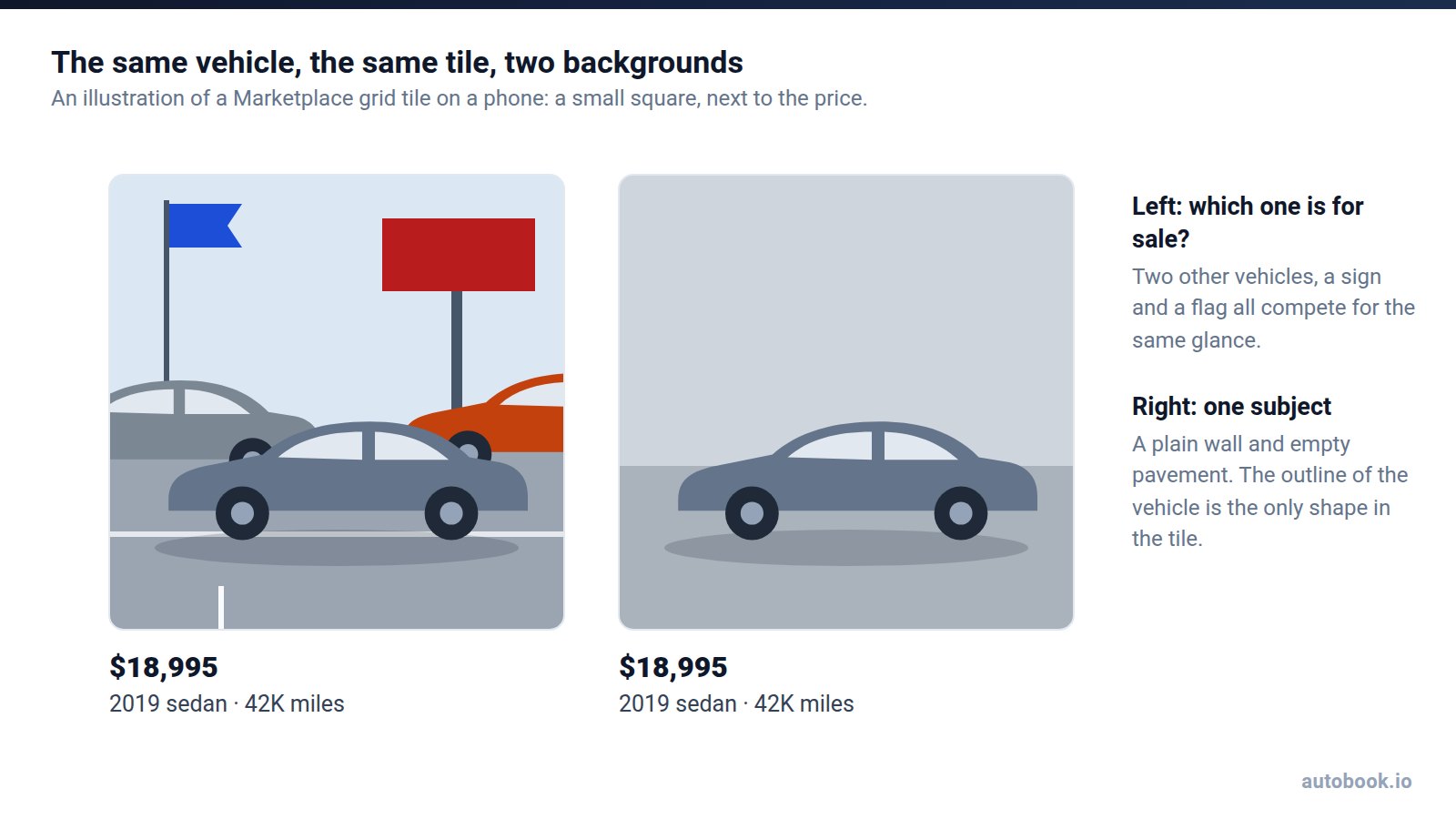
The test fits in three questions. Ask them with the phone up, before you tap the shutter:
- Is the car the highest-contrast thing in the frame?
- Is there anything else with wheels in it?
- Could you shoot the next unit in the same spot?
Three yeses and the background is doing its job. The third question is the one people skip, and it's the one that makes a whole inventory look like it came from one store.
Where do you find a good background on a dealer lot?
You don't need a studio. You need one spot that passes those three questions, and the habit of using it.
| Spot | Why it works | Watch for |
|---|---|---|
| A plain wall: the side or back of the building, a closed bay door | One flat surface, no detail. | Downspouts, a dumpster at the edge of the frame, your own shadow. |
| The empty end of a row | Pavement and open space, nothing with wheels. | Parking lines, cones, and the next unit creeping into the edge. |
| Open shade: the shaded side of the building on a sunny day | Even light, and no hot stripe down the hood. | It's darker, so check that dark paint doesn't turn into a silhouette. |
| A treeline or a grass edge | Dark, soft, and it doesn't read as a lot. | Branches growing out of a tall truck's roofline. |
| The same spot, every unit | Your listings look like a set. | It costs a short drive per unit, and the light moves through the day. |
Pull the vehicle out of the row to shoot it. It takes a few minutes, and the rest of the routine, from the angle to the shot order, is in the dealer shot list.
Then think about contrast, because the outline of the car is what reads in a small tile. Put a darker background behind white, silver and yellow paint, and a lighter one behind black. A white car against a white wall has no edge. It just becomes a pair of wheels and some glass.
Which backgrounds never work?
Some are bad often enough that it's not worth checking:
- Between two other units, however clean they are.
- In front of the showroom glass, which reflects the lot back into the window and into the paint.
- Facing the street.
- Under the store's sign or the flags.
- Open pavement at midday, where the sun puts a hot stripe down the hood and glare on everything else.
- After dark under lot lights, which throw the paint color off.
When does a studio background help, and when does it hurt?
It helps when you can't fix the location. Some stores have no empty corner. Some Saturdays the lot is full. Some units don't move easily. A studio also gives you consistency for free: every unit in the same room, every tile clean, whatever the weather did.
It hurts in two ways.
The first is when it looks fake. A car floating above the floor, a shadow pointing the wrong way, a vehicle too big for the room. A buyer who spots a pasted-on car has a reason to doubt the other nineteen photos. That's what the reflections and floor shadow in our editor are for: so the vehicle sits in the room instead of hovering on it.
The second is worse: when the car has been changed. An AI that "improves" the wheels, smooths a dent or swaps in a cleaner example of the model has made a photo of a vehicle you don't have. Facebook's Commerce Policies say commerce content "may not contain misleading, violent or hateful products and offers." A studio behind the real vehicle isn't misleading. A different vehicle is.
So the honest line is short. Change the scene, never the car. What that means edit by edit is in how to edit car photos for Facebook Marketplace.
One more thing to know before you start. Our AI never touches interiors, so a listing with studio exteriors still has real interiors. That's the right mix, because the real interior is what makes the studio exterior believable. What jars is a studio first photo followed by five exteriors shot in the row. If you put the first photo in a studio, do the other exteriors too, or shoot them against your clean spot.
A studio also doesn't hide that you sell for a dealership, and it shouldn't. Say in the listing that you're a salesperson.
White studio or Turntable: which room should you pick?
Those are the two rooms. There's no third, and you can't upload your own background. White studio is a bright, plain room with a pale floor. Turntable is a similar room with a round platform in the middle.
We haven't measured which one sells better, so we won't pretend to know. What we'd do: preview the same photo in both rooms for free, pick the one that suits your inventory, and use it on every unit. Consistency is the part you control.
Whichever you pick, the AI keeps your angle. A photo taken from standing height still looks down on the car in the studio. Crouch to about headlight height before you shoot, and the room has less to fix.
Does a better background sell the unit faster?
We don't know. We've never measured background against clicks, messages or sales, and we'd be wary of anyone who gives you a number without a method.
The nearest data we have is photo count. We took 802 units that dealers posted through autobook.io and later marked sold, and split them three ways.
| Split by | What we measured | What it showed |
|---|---|---|
| Photos on the listing | Share sold within 30 days | 63.6% to 67.2% across every bucket. No defensible effect. |
| Asking price | Median days to sell | 13.4 under $10,000 to 18.9 at $30,000 and up. A 5.5-day spread. |
| The dealer who posted it | Median days to sell, dealers with 10 or more sales | About 5 days for the fastest to about 52 for the slowest. |
The clock starts at each unit's most recent post, so a repost resets it, and every figure is a floor. The photo-count split, bucket by bucket, is in how many photos a Marketplace car listing needs.
Read the last row against the one above it. The dealer-to-dealer spread is roughly eight times the whole price-band spread. Who posts matters far more than what's posted. Background wasn't in the study, so it isn't in the table, and we won't stretch the photo-count result to cover it.
Our view, for what it's worth: a plain background removes the obvious reasons to scroll past. That's worth a few minutes a unit, even without a number.
Will Facebook label a studio photo as AI?
It can. Meta applies its "AI info" label when it detects industry-standard AI indicators in a file, or when the person posting says the content is AI-generated, according to Meta's Transparency Center. Meta says it keeps labeled content up and adds context unless it breaks another policy.
What gets a vehicle listing pulled is misrepresenting the vehicle. The label, and where our own photos land, is covered in will AI-edited car photos get your listing flagged?
How do you put your inventory in a studio?
For one photo, use the free editor. Upload a whole-car exterior, pick White studio or Turntable, and the same vehicle comes back from the same angle, with reflections and a floor shadow. It removes the license plate and plate frame when it detects them; the plate side of this is in how to remove a license plate from a car photo. You can preview up to 9 photos a day for free and get 3 full-quality photos a day, the full-quality ones with an email. Interiors, close-ups and photos without a car are turned away.
For the whole inventory, there's the AI Image Processor inside autobook.io. It's paid and opt-in, at 2 credits a photo, and you choose the vehicles. It processes every exterior on a unit, up to 6, or only the best one. Interiors and close-ups are skipped and not charged. You review each result against its original and keep it or undo it.
That setting is the real decision. Best photo only costs 2 credits a unit and does one exterior. All exteriors, up to 6, keeps the set consistent, which is the point made above. autobook.io's founder, John Hozjan, sums up the aim: "Improve your inventory photos in a matter of minutes. No experience needed — get the professional photographer feeling without breaking the bank."
A background is one photo decision. The listing takes more. autobook.io imports your dealership's inventory from its website, photos included, and writes an editable description for every unit. It posts to Marketplace from your own profile, in your own browser, and can renew listings where Facebook offers it. You choose the units, answer every buyer in Messenger and close, which is roughly 40 minutes a day. It removes the grind, not the job. Plans start at $99 a month, and across the network about one in nine posted vehicles sells.
Before any of that, try both rooms on one of your own photos in the free AI car photo editor.
Frequently asked questions
What color background is best for car photos?
One that contrasts with the paint: darker behind white and silver, lighter behind black. Plain matters more than the color itself.
Are white background car photos good for Marketplace?
They make a clean tile and a consistent set. They hurt only when the result looks pasted on, or when the car itself has been changed.
Can I upload my own background to the free editor?
No. There are two rooms, White studio and Turntable.
Should I shoot new units inside the showroom?
Only if you can get other units, people and the glass out of the frame. Behind the car, a showroom is usually busier than it looks from the front.
Do studio backgrounds get more messages?
We haven't measured it. The nearest data we have, photo count, showed no defensible effect on how fast units sold.
Does the AI change the car?
No. It keeps the paint, wheels, trim, badges and lettering, and aftermarket modifications. Only the plate and plate frame go, when detected, and it never touches interiors.